President Barack Obama has unveiled plans for America's military future, outlining a historic shift towards a smaller and leaner force that will focus on China and move away from large-scale ground warfare that has dominated the post-9/11 era.
Obama became the first president to announce a strategy change directly from inside the Pentagon – a theatrical gesture designed to underline the significance of the shift. Mindful of the dangers of displaying any weakness over national security in an election year, Obama said he was determined to maintain US military supremacy around the world, but he admitted that the review involved a move to "smaller conventional ground forces" and the removal of "outdated cold war-era systems".
The immediate incentive for the change in tack, set out in a Pentagon strategy paper, is the fiscal crisis and the Congress-led drive for spending cuts. Currently, the Pentagon is under orders to slash $487bn from the resources it had expected to receive over the next 10 years, and those cuts could rise to close to $1tn if Congress fails to reach agreement on alternative reductions by January next year.
Details of the impact of the cuts on military deployments and systems will gradually be rolled out in upcoming budget announcements. For now, Obama and his main advisers, the defence secretary Leon Panetta and general Martin Dempsey, chairman of the joint chiefs of staff, stuck to the highlights.
Among the casualties of the new-look military will be the two elements of the military that have formed the kernel of American global might over the past decade: the army and the marine corps. But with the Iraq war over and US commanders struggling to draw back from Afghanistan, that emphasis on the long-term massive ground mission is seen as fading as a priority, and both will face reductions in personel likely to involve tens of thousands of troops from the current Army numbers of 570,000.
There will also be a move away from the decades-old mantra of US military planners that America must be capable of fighting two wars at any one time. "The two-war paradigm has been an anchor in the way we think about the future. That paradigm is a residual of the cold war," Dempsey said.
That is likely to be siezed upon by Republicans as evidence that the Obama administration is damaging US capability around the world. Obama anticipated that criticism, saying: "Yes our military will be leaner, but the world must know the United States is going to maintain our military superiority with armed forces that are agile, flexible and ready for the full range of contingencies and threats."
For good measure, he added that the defence budget would continue to be larger than it was at the end of George Bush's term, and larger than the military spending of the next 10 countries put together.
"Make no mistake, we will have the capability to defeat more than one force at any time," Panetta concurred.
The dream of a modern military based on speed and stealth rather than overwhelming ground force has long been desired by military strategists. Donald Rumsfeld made a move towards it in the opening months of the Bush era, but was thrown off course by the 9/11 attacks and the angry US reaction to them in Afghanistan and then Iraq.
Now the Pentagon hopes to get back on that track, with new strategic goals and ambitions. Top of that list, the review has concluded, will be the emerging powers of the Asia-Pacific region amid mounting Pentagon concern about China's growing naval power and investment in high-tech weaponry.
"All trends are shifting to the Pacific. Our strategic challenges will largely emanate out of the Pacific region," Dempsey said.
In terms of the fighting force itself, the increasing reliance on technological warfare is certain to be extended, with the unmanned drone as its centrepiece. Critics on the left are likely to focus on that aspect as evidence of the Obama administration's disrespect for international law and civilian lives.
Panetta said: "As we reduce the overall defence budget, we will protect and in some cases increase our investments in special operations forces, new technologies like unmanned systems, space and in particular cyberspace capabilities and in the capacity to quickly mobilise."
Panetta and Dempsey both recognised that cuts in the strength of US troops would carry security risks. But they said the risks were preferable to doing nothing.
Panetta issued a clear and yet unspoken challenge to the Republican majority in the House of Representatives that has led resistance to the administration's budget plans. He said that if Congress continued along its path towards a further $500bn in defence cuts in January, the country's national security would be in jeopardy and there would be demoralisation within what he called a "hollowed" military force.
Showing posts with label USA. Show all posts
Showing posts with label USA. Show all posts
Thursday, 5 January 2012
Obama plans for leaner US military in historic strategy shift
Given the significance of this latest development in the US administration, a large number of outlets feature detailed summaries of announcements made yesterday by President Obama and Defense Secretary Panetta. The Guardian provides some of the best coverage from a UK perspective:

Monday, 28 November 2011
The Ally from Hell
The Atlantic this coming month features a lengthy article examining the relationship between Pakistan and the USA / the West. No excerpts here, but do take time to read it - the article pulls few punches! Here's the opening blurb to provide some flavour:
Pakistan lies. It hosted Osama bin Laden (knowingly or not). Its government is barely functional. It hates the democracy next door. It is home to both radical jihadists and a large and growing nuclear arsenal (which it fears the U.S. will seize). Its intelligence service sponsors terrorists who attack American troops. With a friend like this, who needs enemies?
 |
| Supporters of an Islamic separatist group march a mock nuclear missile through the streets of Karachi, February 2011. (Reuters) |
Sunday, 20 November 2011
The market for state territory - Pass the hemlock
The Economist has published an intriguing little article today—asking us to imagine a world in which countries still traded land for money....
Hellenic opinion was outraged last year when Frank Schäffler, a German politician, advised “bankrupt Greeks” to “sell your islands…and sell the Acropolis too!” That is hardly practical politics: as long as Greece remains a democracy, the political, and perhaps biological, lifespan of a leader who proposed hauling down the flag over even the tiniest Aegean outcrop would be measured in hours.
The furore obscured what Mr Schäffler was proposing: lease, commercial sale or a transfer of sovereignty. The government is already selling some land. The Institute for Strategic and Development Studies, a think-tank in Athens, says the Greek state has €35 billion ($47 billion) of property immediately available, which could cover 10% of its debt. KAPPA, a business lobby, suggests €75 billion. Stefanos Manos, an ex-finance minister, says a new state investment company could manage and dispose of property worth €200 billion. But just imagine that the exasperated northerners were dreaming of something more radical: fully ceding sovereign authority.
Territorial swaps for cash seem unthinkable today. But they were once common, especially when European powers were jostling for land in the New World. The United States’ 1803 purchase of the Louisiana territory from Napoleon for $15m (now $312m) is the most famous case. Germany bought the Caroline Islands, in the Pacific, from Spain in 1899 for 25m pesetas ($107m today). And during the First World War America paid Denmark $25m ($530m) for what are now the United States Virgin Islands, mainly to stop Germany buying them.

In an era of self-determination sales of territory have come to seem anachronistic. But leases, involving a de facto transfer of control, are common. In 2010 Russia extended a deal granting Finland a canal for 50 years, and gave Ukraine concessions worth €30 billion to park its fleet at Sevastopol for 25 more years. Michael Strauss of the Centre for Diplomatic and Strategic Studies in Paris sees “no obvious reason” why countries have stopped buying and selling land. “It’s a totally legitimate way for sovereignty to change under international law.”
Arturas Zuokas, the mayor of Vilnius, has made a teasing offer to Greece; he suggested his country acquire an island as “an exclusive place for rest in the Mediterranean” and “a great global advert for Lithuania”, featuring a spa, museums and a theatre. But he did not say whether he wanted title or sovereignty. Lithuania is forecast to be the euro zone’s fastest-growing economy in 2012, but the €7m on offer would only nibble at Greece’s debts.
The thinness of the market gives little indication of what sovereignty is worth. One guide might be the net present value of future tax payments, minus the net costs of public services disbursed there. Greece’s unusual habits with tax and spending could distort that indicator; but it could tempt an outsider to try to run the territory better. Auctions are the best way of setting prices—but would risk jangling nerves. Iran might find an Aegean island a handy way of foiling NATO’s planned missile-defence shield. Perhaps Greece could scare Germany into softer terms just by threatening such a sale.
Many a private-equity firm has overestimated the profits to be wrung from buy-outs, and the sovereignty market may be no exception. When America bought Alaska from Russia for $7.2m (now $113m), in 1867, some called it folly—and how wrong they were, American schoolbooks declare. But the sceptics might be right. David Barker, a professor at the University of Iowa, says that despite its oil wealth, Alaska was so costly to develop that the Treasury has lost money on the deal.
Friday, 28 October 2011
Michael Totten: Did We Lose in Iraq? No, and Here’s Why
Michael J. Totten, writing today in The New Republic, discusses the veracity of American victory in Mesopotamia in the light of President Obama's announcement of US withdrawal by the year's end. The article also makes interesting reading with regard to regional power plays, past, present—and future:
President Barack Obama has announced that nearly all American soldiers will be home from Iraq by the end of the year. Despite the fact that Iran, as the Middle East’s most serious would-be hegemon, will benefit more than any other country from our regional drawdown, the American and Iraqi governments wish to go their own separate ways.
The president has a campaign promise to keep. Most Americans are tired of sending their money, their sons, and even their daughters to Iraq, and most who haven’t spend money or blood are tired of hearing about it. The Iraqis have been trying to elbow us out for years and hope to regain a measure of sovereignty and respect when we’re finally gone.
It’s risky. In a worst-case scenario, Washington could end up evacuating its embassy a few years from now as we did in Saigon nearly four decades ago. But there’s a big difference between withdrawing from Iraq in 2011 and withdrawing from South Vietnam in 1973: The war in Iraq is over.
That's not to say that Iraq is a model of stability. “Iran is laying low right now and is riding us out,” U.S. Army sergeant Nick Franklin told me in Baghdad two years ago. “When we pull out, though, and they know we're almost out, it will be game on here in Iraq.” By aiding and abetting violent Shia militias and terrorist organizations, Iran has indeed been doing its worst to export its sectarian grievances and repressive political system to Iraq ever since coalition forces chased Saddam Hussein out of his palaces. Tehran is still striving for dominance—not only in Iraq, but everywhere else in the region, as well—and that job will surely be easier without the United States in the way.
The Obama administration knows this perfectly well. “To countries in the region,” Secretary of State Hillary Clinton said earlier this week in Tajikistan, “especially Iraq’s neighbors, we want to emphasize that America will stand with our allies and friends, including Iraq, in defense of our common security and interests.” Obviously she was referring to Iraq’s Iranian neighbor. No one worries that Jordan will nefariously interfere in Iraq any time soon. But Clinton’s assurances are less credible given the imminence of America’s withdrawal. Promoting our interests in Iraq will be a lot harder when our closest military forces are in Kuwait rather than Baghdad.
Even so, Iran’s Islamic Republic regime won’t benefit nearly as much from our withdrawal today as it would have five years ago. Iraq was an absolute disaster in 2006. Before General David Petraeus “surged” thousands of additional counterinsurgency troops to the country, a hurricane of car- and suicide-bombers turned Iraq into the most terrorized place on the face of the earth. Abu Musab al-Zarqawi’s Al Qaeda in Iraq lorded over Ramadi, the capital of Anbar Province, and points beyond. Moqtada al Sadr’s radical Shia Mahdi Army militia had its own Hezbollah-style state-within-a-state with its capital in Sadr City, a vast slum in Baghdad that’s home to millions of people.
If the United States had withdrawn its forces then, as many commentators and policymakers demanded, the Iraqi government almost certainly would have disintegrated. Iraq might not even exist as a state anymore. Al Qaeda could have claimed it beat the United States Marine Corps in a shooting war—a feat far more impressive for the purposes of propaganda than even the killing of thousands of civilians in New York and Washington. Iran, meanwhile, could have successfully replicated the quasi-imperial foreign policy it all but perfected in Lebanon where it acquired its own private army—Hezbollah—during a chaotic time of sectarian civil war and foreign occupation.
Iraq is a completely different country today. Al Qaeda in Iraq scarcely even exists anymore. No militia, either Sunni or Shia, controls territory or has its own “capital” anywhere. Baghdad’s government is not going to fall, no matter how much Tehran tries to undermine it. No one will be able to claim even implausibly that Americans were driven out of Iraq under fire. Nor can anyone plausibly say the United States lost. The enemies of the United States and Iraq’s elected government have either been vanquished, forced to give up the gun, or driven into the shadows.
“In all societies there is an acceptable level of violence,” U.S. Army captain A.J. Boyes said to me in Sadr City in 2009, suggesting that Iraq was reaching that point. Baghdad was no longer the war zone it used to be, and it’s even less violent now that it was then. No society in the world can be completely free of violence, but the “acceptable” level, given factors like history and political grievance, is higher in some countries than in others. It’s higher in the United States than it is in Japan. It’s higher in Mexico than it is in the United States. And it’s higher in Iraq than it is in Mexico. But Iraq today is less violent than Mexico, one of the most heavily touristed countries in the world.
That’s not to say there are no reasons to stay. “If there is one constant of American military history,” Max Boot wrote in Commentary, “it is that the longer our troops stay in a country the better the prospects of a successful outcome. Think of Germany, Italy, Japan or South Korea. Conversely when U.S. troops rush for the exits hard-won wartime gains can quickly evaporate. Think of the post-Civil War South, post-World War I Germany, post-1933 (and post-1995) Haiti, post-1972 Vietnam, or, more recently, post-1983 Lebanon and post-1993 Somalia.”
Boot is right about that. President Obama’s decision to withdraw may well end badly. But if it does turn out to be a mistake, it will be a much smaller mistake than a pre-surge withdrawal would have been. We are no longer staring down the possibility of a military or grand strategic defeat on the battlefield.
Iraq just isn’t as dangerous anymore, not to itself and not to others. If Iran tries to destabilize it with terror militias again, Iraq will fight back. And the Iraqis know how to fight back effectively now after so many years of American training. If Iran actually tries to invade with conventional forces—a spectacularly unlikely event, but one never knows in that part of the world—odds are excellent that the American military would respond to the breach of international law and sovereignty by again joining the fight alongside the Iraqi military.
Iraq has been gearing up to stand on its own for years. President Obama merely decided the time would come sooner rather than later. A Republican president would have eventually made the same decision even if it might have taken a little bit longer. Few Americans are in the mood for any more nation-building or babysitting. Iraqis, for their part, are tired of being built-up and babysat by Americans. Some kind of withdrawal and disengagement has been a long time coming for those reasons alone. A substantial number of American officials were persuaded that sticking around in Iraq to prevent a catastrophe was probably wise as long as we’d leave when a howling abyss no longer yawned at everyone’s feet. For better or for worse, that time has arrived.

Saturday, 8 October 2011
Economist: Flight of the Drones
The Economist looks at why the future of air power belongs to unmanned systems (edited version follows)....
On September 30th Anwar al-Awlaki and several of his al-Qaeda colleagues stopped their pickup truck on a remote, dusty road deep inside Yemen’s interior. He can have had only a split second to realise what was about to happen. But the missile strike that killed al-Qaeda’s most effective propagandist was no real surprise. It was just the latest example of the way America’s armed Predator and Reaper drones are changing the terms of combat with the country’s enemies, leaving them able to run but with nowhere to hide.
American officers, with their passion for acronyms, prefer not to call the machine that killed al-Awlaki a drone. They have a point. In nature, drone bees are poor, useless things that produce no honey and have no sting. That hardly describes the remotely-piloted Predator MQ-1 or Reaper MQ-9 aircraft. Laden with sophisticated sensors and carrying Hellfire missiles and laser-guided bombs, they patrol the skies above Afghanistan, launch lethally accurate strikes against terrorists in the tribal areas of Pakistan, Yemen and Somalia and have helped NATO turn the tide against Muammar Qaddafi’s forces in Libya. Even calling them Unmanned Aerial Vehicles (UAVs) or Unmanned Aerial Systems (UAS) is slightly misleading. There may not be a man in the cockpit, but each Reaper, a bigger, deadlier version of the Predator, requires more than 180 people to keep it flying. A pilot is always at the controls (albeit from a base that might be 7,500 miles, or 12,000km, away); and another officer operates its sensors and cameras.
Over the past decade UAS have become the counter-terrorism weapon of choice. Since 2005 there has been a 1,200% increase in combat air patrols by UAVs. Hardly a month passes without claims that another al-Qaeda or Taliban leader has been taken out by drone-launched missiles. There are now more hours flown by America’s UAS than by its manned strike aircraft and more pilots are being trained to fly them than their manned equivalents. While taking a knife to other cherished defence programmes last year, the defence secretary, Robert Gates, went out of his way to exempt drones from future cuts.
Under Barack Obama, the frequency of drone strikes on terrorists in Pakistan’s tribal areas has risen tenfold, from one every 40 days during George Bush’s presidency to one every four. John Brennan, Mr Obama’s counter-terrorism chief, has made it clear that as America draws down its forces in Afghanistan over the next three years, there will be no let up in drone strikes, which, he claims, are partly responsible for al-Qaeda being “on the ropes”. The grim Reaper’s ability to loiter for up to 24 hours, minutely observe human activity from five miles above while transmitting “full motion video” to its controllers and strike with pinpoint accuracy has made it the essential weapon in America’s “long war”.
But does this mean that the future belongs to UAS? As military thoughts turn to the threat posed by more powerful potential adversaries than jihadist militants—a fast-emerging China, say, or a nuclear-tipped Iran—will their enthusiasm for unmanned aircraft continue unabated? Or will having a pilot in the cockpit making life and death decisions remain the least risky option for the majority of missions, as proponents of the late and wildly over-budget F-35 Joint Strike Fighter, due to enter service in 2016, claim? If the answer favours the drones, then the world may be just at the beginning of a genuine revolution in warfare. It would be a revolution dominated, at least at the start, by America, which accounts for the overwhelming majority of UAS. Other countries, though, such as Britain and Italy, have also been quick to deploy armed drones and Israel, in particular, has a thriving UAS industry, using drones in a wide variety of roles.

The balance of this lengthy but informative article explores the current crop of drones, before examining the burgeoning phenomenon of UAS in the US and beyond.... Speculation also is given to the ethics of UAS and the possibilities for future development, including almost complete automation. Definitely worth a read—take a look!

Friday, 30 September 2011
BBC News: Islamist cleric Anwar al-Awlaki killed in Yemen
BBC News publishes a report regarding the 'targeted killing' (yesterday?) of prominent al-Qaeda leader Anwar al-Awlaki in Yemen by an American drone:
That's an extract: there's more, so take a look!US-born radical Islamist cleric Anwar al-Awlaki, a key al-Qaeda leader, has been killed in Yemen, the country's defence ministry said.
US President Barack Obama said his death was a major blow to al-Qaeda.
Awlaki, of Yemeni descent, has been on the run in Yemen since December 2007.
The US said that as a key figure in al-Qaeda in the Arabian Peninsula (AQAP), he had played a "significant role" in plots to blow up US airliners and had sought use poison to kill US citizens.
Mr Obama is said to have personally ordered his killing last year.
Yemen's defence ministry statement said only that Awlaki had died in Khashef in Jawf province, about 140km (87 miles) east of the capital, Sanaa, "along with some of his companions".
US and Yemeni officials later named one of those as Samir Khan, also a US citizen but of Pakistani origin, who produced an online magazine promoting al-Qaeda's ideology.
Local tribal leaders told the AFP news agency that Awlaki had been moving around within Yemen in recent weeks to evade capture. Local people told AP he had been travelling between Jawf and Marib provinces when he died.
US officials said Awlaki's convoy was hit by a US drone and jet strike.
Mr Obama said that as the leader of external operations for AQAP, Awlaki, born in 1971, had taken "a lead in planning and directing efforts to murder innocent Americans" and was also "directly responsible for the death of many Yemeni citizens".
He said the death marked another "milestone in the broader efforts to defeat al-Qaeda and its affiliates", and paid tribute to US intelligence and the Yemeni security forces for their co-operation.
"This is further proof that al-Qaeda and its affiliates will find no safe haven anywhere in the world, " he said.
British Foreign Secretary William Hague said Awlaki had "demonstrated his intent and ability to cause mass terror".
One US official told the American network ABC that US intelligence had had "a very intense focus" on Awlaki for some time, waiting for a chance to strike.
The unnamed official said there had been "a good opportunity to hit him" on the 10th anniversary of the 9/11 attacks this year, but that "it never materialised".

Sunday, 25 September 2011
FP: The South China Sea Is the Future of Conflict
Robert Kaplan has published an article in the Special Report section of the current edition of Foreign Policy magazine, exploring the potential for conflict within the South China Sea...

A far-reaching, determinedly Realist overview of the developing situation.
This issue of Foreign Policy also includes a link to an evocative photo-essay entitled "Tour the South China Sea". Take a look!

A far-reaching, determinedly Realist overview of the developing situation.
This issue of Foreign Policy also includes a link to an evocative photo-essay entitled "Tour the South China Sea". Take a look!
Wednesday, 21 September 2011
Wired: US Establishes New Drone Bases for African Shadow Wars
Wired magazine's Danger Room reports on American preparations for the next predicted phase of "the drone wars", extending the practical reach of the US as a superpower:
Washington is quietly setting up at least two new East African drone bases, plus one on the Arabian Peninsula, to support the expanding U.S. shadow war against Islamic militants in Somalia and Yemen. An apparently new facility has been built in Ethiopia. In the island nation of Seychelles, a defunct airfield is being reactivated. A third base is being set up in or near Yemen.
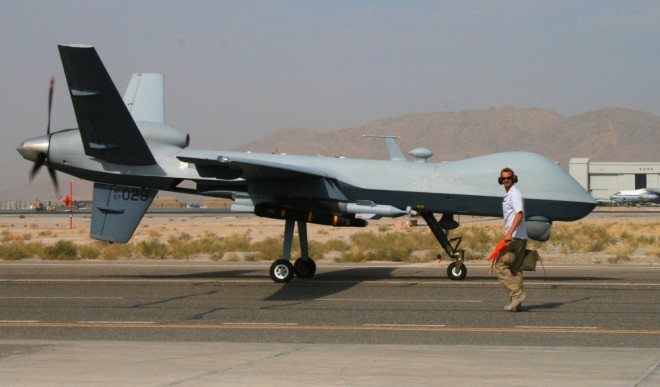
The news, first reported by The Washington Post and The Wall Street Journal, should come as no surprise to close observers of America’s shadow war on the borders of the Indian Ocean. But the base expansion could be met with outrage by the people most directly affected, especially Africans themselves. For years, Washington has insisted that it wouldn’t build new bases in Africa.
The new drone facilities are a small step for a Pentagon and CIA already heavily invested in the Indian Ocean region. While mercenaries and U.S. allies — “proxies” — do most of the fighting in Somalia and Yemen, American warships, aircraft and special operations forces also play an important role. U.S. Reaper or Predator drones have struck militants in Yemen at least six times total in 2010 and 2011. In Somalia, drones have attacked at least twice since 2007. U.S. forces have also hit Somalia’s al-Shabab Islamic group a total of six times, that we know of, using cruise missiles and Special Forces helicopters.
The American base in the tiny country of Djibouti, north of Somalia, provides food and fuel to the warships and serves as a launching pad for the unmanned vehicles and choppers. The Djibouti base has been around since 2001. U.S. Special Forces operated from a small base in Kenya beginning “a few years” prior to 2007, according to military consultant Tom Barnett. American commandos also launched attacks from an unspecified Ethiopian location in early 2007. The Seychelles drone base was open for business in 2009 and 2010 before temporarily shutting down.
Amid all this activity, Washington insisted it had no plans for new African bases. “I want to dispel the notion that all of a sudden America is, you know, bringing all kinds of military to Africa. It’s just simply not true,” then-President George W. Bush told reporters in Ghana in 2008. Bush was trying to reassure African audiences that the new U.S. Africa Command would not mean an expanded U.S. military presence in Africa. Africa Command kept its headquarters in Germany, but the U.S. presence expanded anyways — though many of the forces operate outside of Africa Command’s purview.
For Washington, the rationale for new bases is clear. “We do not know enough about the leaders of the Al Qaeda affiliates in Africa,” a senior U.S. official told The Wall Street Journal. “Is there a guy out there saying, ‘I am the future of Al Qaeda’? Who is the next Osama bin Laden?” If finding and killing the next bin Laden means breaking a promise over African bases, the U.S. seems content with going back on its word.
Sunday, 4 September 2011
The Worst Mistake America Made After 9/11
Anne Appelbaum in a thought-provoking article in Slate magazine today believes that "focusing too much on the war on terror undermined our (the American) economy and global power" (some excerpts):
China is not the only area on which American lost focus, according to Appelbaum—she also cites problems with Russia, with Mexican immigration, with domestic investment, that might not have been the problems they currently are with decreased focus on a war against terror. An interesting perspective vis à vis America's position as still the sole superpower... Do take a look!In the wake of al-Qaida's attack on New York and Washington, an organizing principle suddenly presented itself. Like the Cold War, the new "war on terror," as it instantly became known, clearly defined America's friends, enemies, and priorities. Like the Cold War, the war on terror appealed both to American idealism and to American realism. We were fighting genuine bad guys, but the destruction of al-Qaida also lay clearly within the sphere of our national interests. The speed with which we all adopted this new paradigm was impressive, if somewhat alarming. At the time, I marveled at the neatness and cleanliness of this New New World Order and observed "how like an academic article everything suddenly appears to be."
The events of 9/11 reverberated through many spheres of American life but nowhere more profoundly than in American policy toward the outside world. Slowly, the supertanker that is the American foreign and defense establishment turned itself around, creaking and groaning, as Americans prepared to face new enemies. During the subsequent decade, we created a vast new security bureaucracy, encompassing some 1,200 government organizations, 1,900 companies, and 854,000 people with security clearances, according to a Washington Post investigation carried out last year. We launched two wars, in Afghanistan and Iraq. We organized counterterrorism operations in far-flung places such as the Philippines and Yemen, changed the culture of our military and reoriented our foreign policy. We sharpened our focus on al-Qaida and its imitators. And we spent, according to one estimate, $3 trillion.
And we were, in the terms defined by the war on terror, successful: Ten years after 9/11, al-Qaida is in profound disarray. Osama bin Laden is dead. Fanatical Islam is on the decline. Our military remains the most sophisticated and experienced in the world. And yet, 10 years after 9/11, it's also clear that the war on terror was far too narrow a prism through which to see the entire planet. And the price we paid to fight it was far too high.
In our single-minded focus on Islamic fanaticism, we missed, for example, the transformation of China from a commercial power into an ambitious political power. We failed to appreciate the significance of economic growth in China's neighborhood, too. When President George W. Bush traveled in Asia in the wake of 9/11, he spoke to his Malaysian and Indonesia interlocutors about their resident terrorist cells. His Chinese colleagues, meanwhile, talked business and trade.

Monday, 29 August 2011
CFR Backgrounder: Targeted Killings
The Council for Foreign Relations, a US foreign policy think tank, has published a useful 'backgrounder' article on the phenomenon of "targeted killings" (i.e. assassinations) as currently practised by the US against its enemies abroad. The following sub-topics are discussed:
- What are targeted killings?
- What are the legal considerations surrounding U.S. targeted killings?
- What methods of targeted killing does the United States employ?
- What are the political implications of U.S. targeted killing?
- What is the future of targeted killings?
Saturday, 20 August 2011
Telegraph: US troops may stay in Afghanistan until 2024
Interesting, ongoing developments reported today in the inter-dependency relationship between America and Afghanistan, revealing US attempts at maintaining a strong power relationship in the south and central Asia region for sometime yet...
America and Afghanistan are close to signing a strategic pact which would allow thousands of United States troops to remain in the country until at least 2024, The Daily Telegraph can disclose.
The agreement would allow not only military trainers to stay to build up the Afghan army and police, but also American special forces soldiers and air power to remain.

The prospect of such a deal has already been met with anger among Afghanistan’s neighbours including, publicly, Iran and, privately, Pakistan. It also risks being rejected by the Taliban and derailing any attempt to coax them to the negotiating table, according to one senior member of Hamid Karzai’s peace council.
A withdrawal of American troops has already begun following an agreement to hand over security for the country to Kabul by the end of 2014. But Afghans wary of being abandoned are keen to lock America into a longer partnership after the deadline. Many analysts also believe the American military would like to retain a presence close to Pakistan, Iran and China.
Both Afghan and American officials said that they hoped to sign the pact before the Bonn Conference on Afghanistan in December. Barack Obama and Hamid Karzai agreed last week to escalate the negotiations and their national security advisers will meet in Washington in September.
Rangin Dadfar Spanta, Mr Karzai’s top security adviser, told The Daily Telegraph that “remarkable progress” had been made. US officials have said they would be disappointed if a deal could not be reached by December and that the majority of small print had been agreed. Dr Spanta said a longer-term presence was crucial not only to build Afghan forces, but also to fight terrorism.
“If [the Americans] provide us weapons and equipment, they need facilities to bring that equipment,” he said. “If they train our police and soldiers, then those trainers will not be 10 or 20, they will be thousands.
“We know we will be confronted with international terrorists. 2014, is not the end of international terrorist networks and we have a common commitment to fight them. For this purpose also, the US needs facilities.”
Afghan forces would still need support from US fighter aircraft and helicopters, he predicted. In the past, Washington officials have estimated a total of 25,000 troops may be needed.
Dr Spanta added: “In the Afghan proposal we are talking about 10 years from 2014, but this is under discussion.” America would not be granted its own bases, and would be a guest on Afghan bases, he said. Pakistan and Iran were also deeply opposed to the deal.
Andrey Avetisyan, Russian ambassador to Kabul, said: “Afghanistan needs many other things apart from the permanent military presence of some countries. It needs economic help and it needs peace. Military bases are not a tool for peace.
“I don’t understand why such bases are needed. If the job is done, if terrorism is defeated and peace and stability is brought back, then why would you need bases?
“If the job is not done, then several thousand troops, even special forces, will not be able to do the job that 150,000 troops couldn’t do. It is not possible.”
A complete withdrawal of foreign troops has been a precondition for any Taliban negotiations with Mr Karzai’s government and the deal would wreck the currently distant prospect of a negotiated peace, Mr Avetisyan said. Abdul Hakim Mujahid, deputy leader of the peace council set up by Mr Karzai to seek a settlement, said he suspected the Taliban had intensified their insurgency in response to the prospect of the pact. “They want to put pressure on the world community and Afghan government,” he said.
Friday, 12 August 2011
US War with China "Inevitable", Author Glain Says
Yahoo! Finance's Daily Ticker segment today features an interview with political author Stephen Glaiser, who posits a fairly pessimistic mid- to long-term view of Sino-American relations:
Outside of the market madness, the biggest global news this week might be China sending its first aircraft carrier to sea. The launch was not unexpected and China sought to downplay its significance, saying "it will not pose a threat to other countries."
Still, "it is the most potent symbol yet of China's desire to develop the power both to deny U.S. naval access to Asian waters and to protect its global economic interests, including shipping lanes," The WSJ reports.
Like many others, Stephen Glain, author of State vs. Defense, believes the U.S. and China are, indeed, on a collision course. "Absent a good faith attempt to negotiate this thicket of disputes between China and Taiwan and the Philippines and Brunei and others, I think it's inevitable," he says. "The Chinese are not going to back down."
Just as America adopted the Monroe Doctrine to project power in the Western Hemisphere, the Chinese believe they have a right to their own sphere of influence in the Asia-Pacific region. "China is after all a 3000-year old country; Asia has been throughout most of that history Sino-centric," he says.
But to those who believe the U.S. and its allies must "bottle up" China, Glain says "there's nothing in those 3000 years of Chinese history" to suggest China's intentions are to militarily dominate the region. "On the contrary, they've always remained close to their own territory," he notes. "They have always been the Middle Kingdom between heaven and earth."
However, Glain fears the U.S. and its allies might provoke China into a war that might otherwise be avoidable. "Arms races tend to develop their own immutable momentum," he says, noting the Pentagon is embarking on an "enormous military buildup" in the region.
In his new book, Glain laments the rise of the "military industrial complex" President Eisenhower warned about 50 years ago, suggesting defense contractors and their patrons in Congress and the Pentagon have an undue influence on U.S. foreign policy. American hubris is also playing a role in the march to war, he says.
"Without an admission by the U.S. of its limitations, both fiscal and militarily…I think some kind of conflict between the U.S. and China is inevitable, probably in our lifetime," he says.
Wednesday, 10 August 2011
BBC News: China's first aircraft carrier 'starts sea trials'
BBC News reports today on the 'unveiling' of China's worst kept secret of the last ten years:
Aircraft carrier symbol of China's naval ambitions
China extending military reach
Viewpoint: A new Sino-US high-tech arms race?
The Guardian offers an alternative to the US-centric analysis of rising Chinese military power, focusing instead on the (potential) naval rivalry with India:
China's first aircraft carrier launches with pride amid regional tensions
The article continues, as does other analysis worth checking:The Chinese navy's first aircraft carrier has begun its sea trials, the state-run Xinhua news agency has said. It quoted military sources as saying that the refitted former Soviet warship left its shipyard in the north-east and the trial "would not take a long time".
The move is likely to raise fresh concerns over China's rapid military build-up. Beijing is currently involved in several maritime territorial disputes, particularly in the South China Sea.
The aircraft carrier left its shipyard at Dalian Port in northeast Liaoning Province on Wednesday morning, Xinhua reported.
"Military sources said that the first sea trial was in line with the schedule of the carrier refitting project," it said. "After returning from the sea trial, the aircraft carrier will continue refit and test work." Xinhua did not provide any further details.
The BBC's Michael Bristow in Beijing says China is years away from being able to deploy this carrier as a potent military tool. Even so, the country's neighbours will be worried.
Many are involved in disputes with China over maritime borders - and they will be looking anxiously at Beijing's naval build-up, our correspondent says.

Aircraft carrier symbol of China's naval ambitions
China extending military reach
Viewpoint: A new Sino-US high-tech arms race?
The Guardian offers an alternative to the US-centric analysis of rising Chinese military power, focusing instead on the (potential) naval rivalry with India:
China's first aircraft carrier launches with pride amid regional tensions
Last week, Japan's annual defence report said the Chinese navy were likely to increase activities around Japan and warned that China had acted "in a way seen as coercive" in conflicts. Beijing responded by accusing Tokyo of irresponsible exaggeration. The test is a small step in the long journey towards building a viable carrier group, but it is already stoking unease in India, and prompting fears of an arms race between Asia's two emerging powers.
The Indian Ocean is fast becoming a zone of contested influence between Beijing and Delhi. Indian strategists have been particularly worried by a string of ports constructed with Chinese assistance in Burma, Sri Lanka and Pakistan.
"The carrier will add a new dimension to the burgeoning Chinese navy which could provide a major challenge to India in its backyard, the Indian Ocean," the Times of India commented on Wednesday.
Despite a £10bn modernisation programme, much of the Indian armed forces' on equipment is outdated, and efforts to build or buy aircraft carriers have been hampered by political wrangling and red tape.
The Indian navy has a small 50-year old 28,000-tonne carrier, which it bought from the UK in 1987, but it aims to have at least two aircraft carrier battle groups in operation by 2015.
The ongoing refit of the 44,570-tonne Admiral Gorshkov, purchased from Russia in 2005, and the construction in India of a new 40,000-tonne carrier are expected to be completed in the coming three to four years."We are definitely looking at deploying two aircraft carriers by the middle of this decade,'' assistant chief of naval staff (foreign cooperation and intelligence) Rear Admiral Anil Chawla said earlier this year.
Defence analyst Ajaj Shukla said that India retains the lead in naval aviation, but that there was a clear fear of "the projection of Chinese power into the northern Indian Ocean in a new way".
"The Chinese are at an earlier stage but once they set their minds to operating a naval air arm they will catch up pretty fast so it is being carefully watched," he said.
Friday, 29 July 2011
US accuses Iran of aiding al-Qaeda
Today's Washington Post reports on serious accusations leveled by the US Government against Iran:
The Obama administration said Thursday that Iran is helping al-Qaeda funnel cash and recruits into Pakistan for its international operations, the most serious U.S. allegation to date of Iranian aid to the terrorist group.
Documents filed by the Treasury Department accuse Iran of facilitating an al-Qaeda-run support network that transfers large amounts of cash from Middle East donors to al-Qaeda’s top leadership in Pakistan’s tribal region.
A Syrian national who directs the network has been allowed to operate in Iran since 2005, and senior Iranian officials know about money transfers and allow the movement of al-Qaeda foot soldiers through its territory, administration officials said.
Although U.S. officials have repeatedly accused Iran of assisting al-Qaeda, links between the two have been difficult to prove. Al-Qaeda regards the Shiite denomination, the dominant branch of Islam in Iran, as heretical, and Iran has sought at times to crack down on the terrorist group, deporting some operatives and holding others under house arrest.
U.S. officials asserted that the alleged network offered new evidence of Iranian support. “By exposing Iran’s secret deal with al-Qaeda, allowing it to funnel funds and operatives through its territory, we are illuminating yet another aspect of Iran’s unmatched support for terrorism,” said David S. Cohen, the Treasury Department’s undersecretary for terrorism and financial intelligence.
The new allegations against Iran come as the administration is seeking to increase international pressure on the Islamic republic. The White House has successfully pushed for additional sanctions against Iranian companies while renewing accusations that the country’s leaders support militias inside Iraq that carry out attacks against U.S. forces.
On Thursday, Iran denied any links to terrorism. Alireza Miryousefi, a spokesman for Iran’s mission to the United Nations, accused U.S. officials of attempting to tarnish Iran’s reputation with “baseless allegations.”
“Iran itself has been a victim of acts of terrorism in the past which have resulted in the loss of hundreds of innocent Iranian lives,” Miryousefi said. “Iran has always opposed supporting and financing terrorist groups such as al-Qaeda.”
The allegations of a Iran-to-Pakistan network center on a Syrian operative, Ezedin Abdel Aziz Khalil. Khalil has directed the flow of cash and recruits from Persian Gulf states to Pakistan through Iran, according to U.S. officials and documents.
The Treasury Department imposed sanctions on Khalil and five other alleged operatives, including Atiyah Abd al-Rahman, a senior al-Qaeda leader on the Pakistani end of the pipeline. Rahman, a top spiritual adviser to al-Qaeda, was a longtime aide to Osama bin Laden, the al-Qaeda leader slain this year in Pakistan, and he once served as a bin Laden-appointed emissary to the Iranian government.
Individual operatives collected large amounts of cash, sometimes in the hundreds of thousands of dollars, and the money passed through Iraq by way of couriers or informal transfer systems known as hawalas, U.S. officials said. Much of the money was collected in Kuwait and Qatar, two countries that administration officials say have been relatively lax about stanching the flow of money from wealthy Arab donors to al-Qaeda.
.....
Many U.S. counterterrorism officials think that al-Qaeda has been weakened by the death of bin Laden and other top leaders, but the flow of money into the group’s coffers has allowed it to continue to operate, the official said. “Al-Qaeda is not destitute, but it is not flush,” he said. “Now is the time to be tightening the screws.”
Although Shiite-led Iran and Sunni-dominated al-Qaeda are theologically opposed, Iran’s ruling clerics have occasionally aided al-Qaeda, particularly in permitting its operatives to travel through Iranian territory. Army Gen. David H. Petraeus, the Obama administration’s new choice to head the CIA, told Congress last year that al-Qaeda was using Iran as a “key facilitation hub, where facilitators connect al-Qaeda’s senior leadership to regional affiliates.”
“And although Iranian authorities do periodically disrupt this network by detaining select al-Qaeda facilitators and operational planners, Tehran’s policy in this regard is often unpredictable,” Petraeus said in written testimony to the Senate Foreign Relations Committee.
Thursday, 28 July 2011
China’s Plan to Beat USA: Missiles, Missiles and More Missiles
Wired's Danger Room series carried an interesting article yesterday, revealing the weaknesses not-so-immediately apparent in China's developing military strength—as well as the Chinese attempts to 'plug the gaps':
China is militarily weaker than many people think, especially compared to the United States. This, despite lots of showy jet prototypes and plenty of other factory-fresh equipment.
But Beijing has a brutally simple — if risky — plan to compensate for this relative weakness: buy missiles. And then, buy more of them. All kinds of missiles: short-range and long-range; land-based, air-launched and sea-launched; ballistic and cruise; guided and “dumb.”
Those are the two striking themes that emerge from Chinese Aerospace Power, a new collection of essays edited by Andrew Erickson, an influential China analyst with the U.S. Naval War College.

Today, the PLA possesses as many as 2,000 non-nuclear ballistic and cruise missiles, according to Chinese Aerospace Power. This “growing arsenal of increasingly accurate and lethal conventional ballistic and land-attack cruise missiles has rapidly emerged as a cornerstone of PLA warfighting capability,” Mark Stokes and Ian Easton wrote. For every category of weaponry where the People’s Liberation Army (PLA) lags behind the Pentagon, there’s a Chinese missile to help make up the difference.
The need is clear. Despite introducing a wide range of new hardware in recent years, including jet fighters, helicopters, destroyers, submarines and a refurbished Russian aircraft carrier, China still lacks many of the basic systems, organizations and procedures necessary to defeat a determined, well-equipped foe.
Take, for example, aerial refueling. To deploy large numbers of effective aerial tankers requires the ability to build and support large jet engines — something China cannot yet do. In-air refueling also demands planning and coordination beyond anything the PLA has ever pulled off. As a result, “tanker aircraft are in short supply” in the PLA, Wayne Ulman explained.
That’s putting it lightly. According to Chinese Aerospace Power, the entire PLA operates just 14 H-6U tankers, each carrying 17,000 kilograms of off-loadable fuel. (The U.S. Air Force alone possesses more than 500 tankers, each off-loading around 100,000 kilograms of fuel.) So while the PLA in theory boasts more than 1,500 jet fighters, in reality it can refuel only 50 or 60 at a time, assuming all the H-6 tankers are working perfectly.
In an air war over Taiwan, hundreds of miles from most Chinese bases, only those 50 fighters would be able to spend more than a few minutes’ flight time over the battlefield. Factoring in tankers, China’s 4–1 advantage in jet fighters compared to Taiwan actually shrinks to a roughly 7&ndash1 disadvantage. The gap only grows when you add U.S. fighters to the mix.
The PLA’s solution? Missiles, of course. Up to a thousand ballistic and cruise missiles, most of them fired by land-based launchers, “would likely comprise the initial strike” against Taiwan or U.S. Pacific bases, Ulman wrote. The goal would be to take out as many of an opponent’s aircraft as possible before the dogfighting even begins.
The PLA could take a similar approach to leveling its current disadvantage at sea. Submarines have always been the most potent ship-killers in any nation’s inventory, but China’s subs are too few, too noisy and their crews too inexperienced to take on the U.S. Navy. Once the shooting started, the “Chinese submarine force would be highly vulnerable,” Jeff Hagen predicted.
And forget using jet fighters armed with short-range weapons to attack the American navy. One Chinese analyst referenced in Chinese Aerospace Power estimated it would take between 150 and 200 Su-27-class fighters to destroy one U.S. Ticonderoga-class cruiser. The entire PLA operates only around 300 Su-27s and derivatives. The U.S. Navy has 22 Ticonderoga cruisers.
Again, missiles would compensate. A “supersaturation” attack by scores or hundreds of ballistic missiles has the potential of “instantly rendering the Ticonderoga’s air defenses useless,” Toshi Yoshihara wrote. Close to shore, China could use the older, less-precise, shorter-range missiles it already possesses in abundance. For longer-range strikes, the PLA is developing the DF-21D “carrier-killer” missile that uses satellites and aerial drones for precision targeting.
The downside to China’s missile-centric strategy is that it could represent a “single point of failure.” Over-relying on one weapon could render the PLA highly vulnerable to one kind of countermeasure. In this case, that’s the Pentagon’s anti-ballistic-missile systems, including warships carrying SM-3 missiles and land-based U.S. Army Patriot and Terminal High-Altitude Air-Defense batteries.
Plus, missiles are one-shot weapons. You don’t get to reuse them the way you would a jet fighter or a destroyer. That means, in wartime, China has to win fast — or lose. “China’s entire inventory of conventional ballistic missiles, for example, could deliver about a thousand tons of high explosives on their targets,” Roger Cliff explained. “The U.S. Air Force’s aircraft, by comparison, could deliver several times that amount of high explosives every day for an indefinite period.”
Friday, 10 June 2011
Guardian: NATO faces dim future, warns Pentagon chief
The Guardian reports today on an extremely hard-hitting speech by US Secretary of Defence Robert Gates on the (possibly) precarious future of the NATO alliance (full article follows):
The US defence secretary, Robert Gates, has launched a blistering attack on European defence complacency, saying Nato has become a "two-tiered" alliance of those willing to wage war and those only interested in "talking" and peacekeeping.

In his bluntest warning in nearly five years as the Pentagon head under two US presidents, Gates announced that Washington's fading commitment to European security could spell the death of the 60-year-old alliance.
In a valedictory speech in Brussels three weeks before retiring, Gates bristled with exasperation and contempt for European defence spending cuts, inefficiencies and botched planning, and read the riot act to an elite European audience.
Nato faced a "dim, if not dismal" future, consigned to "collective military irrelevance", Gates said, warning for the first time that the organisation was living on borrowed time and that a new young generation of US leaders could abandon the key pillar of transatlantic security, established in 1949.
"If current trends in the decline of European defence capabilities are not halted and reversed, future US political leaders – those for whom the cold war was not the formative experience that it was for me – may not consider the return on America's investment in Nato worth the cost," he said.
He attacked Europe's conduct of the bombing campaign against Muammar Gaddafi in Libya, told the Europeans to forget any notions of pulling their troops out of Afghanistan in a piecemeal manner, and said the big new factor raising questions about Nato's survival was the "political and economic environment in the United States".
"The mightiest military alliance in history is only 11 weeks into an operation against a poorly armed regime in a sparsely populated country," Gates said of the Anglo-French led campaign in Libya.
"Yet many allies are beginning to run short of munitions, requiring the US, once more, to make up the difference."
The US share of Nato military spending had soared to 75%, much more than during the cold war heyday when Washington maintained hundreds of thousands of US troops across Europe, he said.
He warned that the US taxpayer would not stand for it much longer – the US Congress and "the American body politic writ large" would rebel against spending "increasingly precious funds on behalf of nations apparently willing and eager for American taxpayers to assume the growing security burden left by reductions in European defence budgets".
Nato had degenerated into an alliance "between those willing and able to pay the price and bear the burdens of commitments, and those who enjoy the benefits of Nato membership but don't want to share the risks and the costs", Gates said.
Noting that he was 20 years older than President Barack Obama, he said Washington's security guarantees to Europe, embodied in the Nato alliance, were fading. His peers' "emotional and historical attachment" to Nato was "ageing out", he said, adding: "You have a lot of new members of Congress who are roughly old enough to be my children or grandchildren."
Generational change, economic hardship and European refusal to take responsibility for their own security were all feeding Nato's decline and possible end, he warned.
"The drift of the past 20 years can't continue," Gates said. "In the past, I've worried openly about Nato turning into a two-tiered alliance, between members who specialise in 'soft' humanitarian, development, peacekeeping, and talking tasks, and those conducting the "hard" combat missions ... This is no longer a hypothetical worry. We are there today. And it is unacceptable."
In March, all 28 Nato members had voted for the Libya mission, he noted. "Less than half have participated, and fewer than a third have been willing to participate in the strike mission," he said.
"Frankly, many of those allies sitting on the sidelines do so not because they do not want to participate, but simply because they can't. The military capabilities simply aren't there."
In a withering attack on the European defence establishment, he blasted allies for slashing defence budgets, but admitted there was little chance of reversing the trend.
"The blunt reality is that there will be dwindling appetite and patience in the US Congress to expend increasingly precious funds on behalf of nations that are apparently unwilling to devote the necessary resources or make the necessary changes to be serious and capable partners in their own defence," he said.
Tuesday, 31 May 2011
Thomas L. Friedman: The Bin Laden Decade
New York Times op-ed columnist weighs in today with a long view back over the "Bin Laden Decade"—he makes some good points!
Visiting the Middle East last week, and then coming back to Washington, I am left with one overriding impression: Bin Laden really did a number on all of us.
I am talking in particular about the Arab states, America and Israel — all of whom have deeper holes than ever to dig out of thanks to the Bin Laden decade, 2001 to 2011, and all of whom have less political authority than ever to make the hard decisions needed to get out of the holes.Take the time to read the whole piece.
Wednesday, 25 May 2011
Obama: Now is time for US and West to lead
BBC News reports on the content of US President Barack Obama's speech today to UK parliamentarians in Westminster Hall, revealing that the President appears to have been reading our exam syllabus (!):
The report also outlines the setting and summary of the President's historic speech:In his speech, Mr Obama... :
- Acknowledged differences in the US and UK approach to deficit reduction but said their end goal was the same
- Insisted the allies were preparing to "turn a corner" in Afghanistan - allowing Afghans to take the lead against the Taliban and stopping the country from becoming a haven for terrorists
- Warned North Korea and Iran against flouting their obligations on nuclear weapons
- Vowed to worked for a resolution to long-running conflicts like that in Sudan, and in supporting a "secure Israel and a sovereign Palestine"
- Defended action in Libya - saying the intervention had "stopped a massacre"

President Obama has told British politicians that, despite the rise of new global powers, the time for US and European leadership "is now".The Guardian, like most other newspapers, also covered the speech—and included a convenient video summary:
He said the influence of the US, UK and allies would remain "indispensable," in a speech in Parliament on the second day of his UK state visit.
But he said that leadership would need to "change with the times" to reflect economic and security challenges.
He is the first US president to address MPs and peers in Westminster Hall.
Rows of the UK's most senior politicians and other prominent figures lined the historic building to hear the US president talk about the history of the UK's relationship with the United States and its shared values - and outline some of the future challenges facing the world.
Former British prime ministers Sir John Major, Tony Blair and Gordon Brown sat next to each other in the packed hall - the oldest part of the Houses of Parliament - which fell silent as the US president began his 35-minute speech.
As he began, Mr Obama joked that with an "especially active press corps", the relationship between the UK and US was forever being "over analysed".
But he added: "There are few nations that stand firmer, speak louder and fight harder to defend democratic values around the world than the United States and the United Kingdom."
Thursday, 19 May 2011
Chinese general: we 'will not match' US military power
BBC News reports comments made yesterday by Chinese General Chen Bingde, currently touring the USA:

China has no intention to match US military power, a top Chinese general has said. Speaking in Washington, Gen Chen Bingde said America's armed forces remained far more advanced than China's despite considerable progress by China in recent years.
But Gen Chen warned that further US arms sales to Taiwan could damage US-China military relations. China regards Taiwan as a renegade province that must be reunited.
"China never intends to challenge the US," Gen Chen, chief of the General Staff of the People's Liberation Army, said at the National Defense University during his week-long visit to the US.
"Although China's defence and military development has come a long way in recent years, a gaping gap between you and us remains."

But Gen Chen warned that US-Chinese relations would suffer if Washington again sold weapons to Taiwan.
As you might expect, these comments have significant bearing on the question of China as a superpower, and the nature of American decline (if in fact it exists!)
"As to how bad the impact will be, it will depend on the nature of the weapons sold to Taiwan," he said.
Last year, Beijing cut off most military-to-military contacts with the US after Washington announced more than $6bn (£4bn) arms sales to Taipei.
Gen Chen's visit to the US has drawn a strongly favourable press in China - a signal of the importance that the Chinese authorities are now placing on better military ties, the BBC's defence correspondent Jonathan Marcus says. But there should be no illusions, our correspondent says, as superficial harmony inevitably masks significant underlying tensions. The aim of China's extensive military modernisation, he adds, is to extend its military reach well beyond its own shores and to potentially neutralise weapons systems where the US has a dominant advantage.
Monday, 2 May 2011
BBC News: US forces kill Osama Bin Laden in Pakistan
HUGE news this morning as US President Barack Obama announces the killing of Osama Bin Laden in Pakistan, on his orders, by US forces:
President Obama's speech can also be seen in full on the BBC News website.
 Stay tuned to this story: We have yet to hear the full details, I believe, with regard to Pakistan's involvement in Bin Laden's hiding and eventual killing...
BBC News has put extensive coverage in place (tabs at top of page), with live updates, background information on the raid, an analysis of possible future reprisals, as well as reaction in the USA and wider afield.Bin Laden was killed in a ground operation outside Islamabad based on US intelligence, the first lead for which emerged last August.
Mr Obama said after "a firefight", US forces took possession of the body.
Bin Laden is believed to be the mastermind of the attacks on New York and Washington on 11 September 2001 and a number of others. He was top of the US' "most wanted" list. Mr Obama said it was "the most significant achievement to date in our nation's effort to defeat al-Qaeda".
The US has put its embassies around the world on alert, warning Americans of the possibility of al-Qaeda reprisal attacks for Bin Laden's killing.
Crowds gathered outside the White House in Washington DC, chanting "USA, USA" after the news emerged.
A US official quoted by Associated Press news agency said Bin Laden's body had been buried at sea, although this has not been confirmed.

President Obama's speech can also be seen in full on the BBC News website.

Subscribe to:
Posts (Atom)