BEIRUT (Reuters) - United Nations chief Ban Ki-moon demanded Friday the disarmament of the anti-Israel Lebanese Hezbollah movement, which had said his visit to Lebanon was not welcome. "I am deeply concerned about the military capacity of Hezbollah and ... the lack of progress in disarmament," he told a news conference after meeting Lebanese leaders.
"That is why we discussed this matter very seriously and I strongly encouraged President (Michel) Suleiman to initiate a convening of this national dialogue to address these issues... "All these arms outside of the authorized state authority, it's not acceptable," Ban declared.
The secretary-general's trip made waves even before he arrived, with one Hezbollah leader saying he was not welcome, a stance criticized by Lebanese politicians opposed to the armed Shi'ite Islamist movement and its Syrian and Iranian patrons.
Hezbollah accepted an expansion of the U.N. Interim Force in Lebanon (UNIFIL) in the south after its devastating 2006 war with Israel, but rejects a U.N. Security Council resolution that demands that it lay down its military arsenal, as all other Lebanese armed groups did after the 1975-90 civil war. UNIFIL troops came under three attacks last year in which Italian and French soldiers were wounded. A rocket was launched into Israel in November and another rocket launching was attempted last month. No group claimed responsibility.
"There are no explicit fears that there is a new climate of hostility to the United Nations," a diplomatic source said. "But there is concern, which the secretary-general will emphasize, over the attacks (on UNIFIL) in May, July and December."
UNIFIL, now about 12,000 strong, is the third biggest U.N. peacekeeping operation and one of the oldest, beginning after an Israeli invasion against Palestinian guerrillas in 1978. The Lebanese army has taken on a bigger role in the south since 2006, but given the tensions between Israel and Hezbollah, there is no sign of an exit strategy for the U.N. force there.
TROUBLED TRIBUNAL
Hezbollah, the most powerful faction in Lebanon, is also angry at the indictment by the U.N.-backed Special Tribunal for Lebanon (STL) of four of its members over the assassination of Lebanese statesman Rafik al-Hariri on Beirut's seafront in 2005. It denies any part in the bombing that killed Hariri and 22 others and vows not to hand over the indicted men. Hezbollah also wants Lebanon's unity government, of which it is a part, to cut off funding for the tribunal and end cooperation with it.
Lebanon paid $32 million, its 49 percent share of the costs, in November, using a maneuver by which Lebanese banks gave the money to a special fund whose use did not need cabinet approval. Ban said the United Nations "continues to expect Lebanon to support and cooperate fully with the Special Tribunal."
The U.N. chief said he would decide soon, in consultation with the Security Council and the Lebanese government, whether to extend the STL's mandate, which expires in March. Ban, due to speak Sunday at a conference on democratic transitions, said he had repeatedly urged Syria to halt the killings that have turned a 10-month revolt against President Bashar al-Assad into one of the bloodiest of Arab uprisings.
"The Syrian authorities must respond to the legitimate democratic aspirations of the Syrian people," he told the Beirut daily an-Nahar, adding that the Security Council, so far divided over Syria, should speak with one voice on the issue.
The United Nations says more than 5,000 people have been killed in the unrest, which Syria blames on armed "terrorists" it says have killed 2,000 members of the security forces.
Russia and China have blocked any firm Security Council action against Syria. The Arab League has sent monitors to find out if Damascus is complying with an Arab peace plan. If their report next week is negative, it may refer Syria to the council.
Showing posts with label terrorism. Show all posts
Showing posts with label terrorism. Show all posts
Friday, 13 January 2012
Disarm Hezbollah, UN chief tells Lebanon
Reuters are reporting today on the UN Secretary-General's current visit to Lebanon—he's been rather outspoken and it could be said that his presence there is widely unwelcome... Good to see that the UN's top official is actually speaking truth to the situation: Someone actually remembered UN Resolution 1559, after which Hizballah was the only group from the Lebanese civil war that failed to disarm. I suspect it will take more than Ban-Ki Moon's words to deal with Hezbollah, however...


Monday, 28 November 2011
The Ally from Hell
The Atlantic this coming month features a lengthy article examining the relationship between Pakistan and the USA / the West. No excerpts here, but do take time to read it - the article pulls few punches! Here's the opening blurb to provide some flavour:
Pakistan lies. It hosted Osama bin Laden (knowingly or not). Its government is barely functional. It hates the democracy next door. It is home to both radical jihadists and a large and growing nuclear arsenal (which it fears the U.S. will seize). Its intelligence service sponsors terrorists who attack American troops. With a friend like this, who needs enemies?
 |
| Supporters of an Islamic separatist group march a mock nuclear missile through the streets of Karachi, February 2011. (Reuters) |
Friday, 30 September 2011
BBC News: Islamist cleric Anwar al-Awlaki killed in Yemen
BBC News publishes a report regarding the 'targeted killing' (yesterday?) of prominent al-Qaeda leader Anwar al-Awlaki in Yemen by an American drone:
That's an extract: there's more, so take a look!US-born radical Islamist cleric Anwar al-Awlaki, a key al-Qaeda leader, has been killed in Yemen, the country's defence ministry said.
US President Barack Obama said his death was a major blow to al-Qaeda.
Awlaki, of Yemeni descent, has been on the run in Yemen since December 2007.
The US said that as a key figure in al-Qaeda in the Arabian Peninsula (AQAP), he had played a "significant role" in plots to blow up US airliners and had sought use poison to kill US citizens.
Mr Obama is said to have personally ordered his killing last year.
Yemen's defence ministry statement said only that Awlaki had died in Khashef in Jawf province, about 140km (87 miles) east of the capital, Sanaa, "along with some of his companions".
US and Yemeni officials later named one of those as Samir Khan, also a US citizen but of Pakistani origin, who produced an online magazine promoting al-Qaeda's ideology.
Local tribal leaders told the AFP news agency that Awlaki had been moving around within Yemen in recent weeks to evade capture. Local people told AP he had been travelling between Jawf and Marib provinces when he died.
US officials said Awlaki's convoy was hit by a US drone and jet strike.
Mr Obama said that as the leader of external operations for AQAP, Awlaki, born in 1971, had taken "a lead in planning and directing efforts to murder innocent Americans" and was also "directly responsible for the death of many Yemeni citizens".
He said the death marked another "milestone in the broader efforts to defeat al-Qaeda and its affiliates", and paid tribute to US intelligence and the Yemeni security forces for their co-operation.
"This is further proof that al-Qaeda and its affiliates will find no safe haven anywhere in the world, " he said.
British Foreign Secretary William Hague said Awlaki had "demonstrated his intent and ability to cause mass terror".
One US official told the American network ABC that US intelligence had had "a very intense focus" on Awlaki for some time, waiting for a chance to strike.
The unnamed official said there had been "a good opportunity to hit him" on the 10th anniversary of the 9/11 attacks this year, but that "it never materialised".

Wednesday, 21 September 2011
Wired: US Establishes New Drone Bases for African Shadow Wars
Wired magazine's Danger Room reports on American preparations for the next predicted phase of "the drone wars", extending the practical reach of the US as a superpower:
Washington is quietly setting up at least two new East African drone bases, plus one on the Arabian Peninsula, to support the expanding U.S. shadow war against Islamic militants in Somalia and Yemen. An apparently new facility has been built in Ethiopia. In the island nation of Seychelles, a defunct airfield is being reactivated. A third base is being set up in or near Yemen.
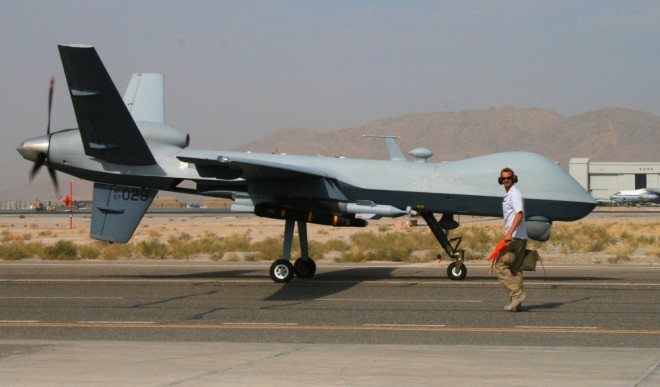
The news, first reported by The Washington Post and The Wall Street Journal, should come as no surprise to close observers of America’s shadow war on the borders of the Indian Ocean. But the base expansion could be met with outrage by the people most directly affected, especially Africans themselves. For years, Washington has insisted that it wouldn’t build new bases in Africa.
The new drone facilities are a small step for a Pentagon and CIA already heavily invested in the Indian Ocean region. While mercenaries and U.S. allies — “proxies” — do most of the fighting in Somalia and Yemen, American warships, aircraft and special operations forces also play an important role. U.S. Reaper or Predator drones have struck militants in Yemen at least six times total in 2010 and 2011. In Somalia, drones have attacked at least twice since 2007. U.S. forces have also hit Somalia’s al-Shabab Islamic group a total of six times, that we know of, using cruise missiles and Special Forces helicopters.
The American base in the tiny country of Djibouti, north of Somalia, provides food and fuel to the warships and serves as a launching pad for the unmanned vehicles and choppers. The Djibouti base has been around since 2001. U.S. Special Forces operated from a small base in Kenya beginning “a few years” prior to 2007, according to military consultant Tom Barnett. American commandos also launched attacks from an unspecified Ethiopian location in early 2007. The Seychelles drone base was open for business in 2009 and 2010 before temporarily shutting down.
Amid all this activity, Washington insisted it had no plans for new African bases. “I want to dispel the notion that all of a sudden America is, you know, bringing all kinds of military to Africa. It’s just simply not true,” then-President George W. Bush told reporters in Ghana in 2008. Bush was trying to reassure African audiences that the new U.S. Africa Command would not mean an expanded U.S. military presence in Africa. Africa Command kept its headquarters in Germany, but the U.S. presence expanded anyways — though many of the forces operate outside of Africa Command’s purview.
For Washington, the rationale for new bases is clear. “We do not know enough about the leaders of the Al Qaeda affiliates in Africa,” a senior U.S. official told The Wall Street Journal. “Is there a guy out there saying, ‘I am the future of Al Qaeda’? Who is the next Osama bin Laden?” If finding and killing the next bin Laden means breaking a promise over African bases, the U.S. seems content with going back on its word.
Thursday, 8 September 2011
Al-Qaida: spent force or spark for future generations of Islamic militants?
Jason Burke, Guardian correspondent whose book The 9/11 Wars comes out this month, writes in today's edition about the dangers of complacency vis à vis al-Qaida:
It is the biggest terrorism trial ever staged in Saudi Arabia. In the dock are nearly 100 men and women accused of attacks in the country. The testimony describes bloody assaults on compounds full of expatriates and bombings of government buildings. The accused will almost certainly be found guilty and many will be executed.
But in many respects this feels like a court case from another era. The current trial relates to episodes from 2003 and 2004, which might just turn out to be the heyday of the Islamist terrorism phenomenon known as al-Qaida.
"In the last two or three years al-Qaida in Saudi Arabia is dying," said Dr Abdul Rahman al-Hadlaq, senior adviser to the ministry of the interior in Riyadh. The most recent terrorist incident in the kingdom was several months ago: a checkpoint shooting involving a militant returned from Guantánamo Bay.
 |
| Osama bin Laden's death impacted on al-Qaida's power and influence around the world, but it was already waning, say security experts. |
Around the world, the assessments of most counter-terrorist officials about the health of violent Islamic extremism in the areas they watch are close to that of al-Hadlaq. So far, this year has seen less terrorist violence associated with al-Qaida than any other since the millennium, arguably the late 1990s. Despite the obvious significance of the date, "there have been no credible … threats against the United States yet ahead of the 10th anniversary of the September 11 attacks," the US homeland security secretary, Janet Napolitano, recently told reporters.
In Afghanistan, US and other western intelligence officials told the Guardian there were only around 100 al-Qaida fighters and of those only "a handful" posed an international threat. There is a residual presence in parts of north Africa but not one that menaces Europe, according to France's top counter-terrorist judge.
In Iraq, al-Qaida is a shadow of its former self and resurgent groups in Yemen and Somalia, only tenuously linked to the senior leadership based in Pakistan, cannot make up for the organisation's loss of capacity elsewhere, analysts say. "The CT [counter terrorist] specialists are worried but neither Yemen nor east Africa are a strategic threat," said one western security official. Islamic extremists have been marginal to the events of the Arab spring, many point out. And of course Osama bin Laden, the founder of al-Qaida and its leader, is now dead, killed in an American special forces raid on a compound in Pakistan in May.
"Al-Qaida has been hollowed out," said a British security source. "Of the 10 top people we were most interested in a few years ago, only one is still alive. Maybe we will look back at the first decade of this century as an aberration when a small number of people threatened a superpower."
Yet after many years of officials and politicians stressing the threats posed by al-Qaida – often represented as a global terror network with the ability to launch devastating strikes almost at will – this declaration of victory seems rather sudden. So what is the true picture?
Life for militants
In late June last year a German jihadi volunteer called Rami Makanesi was detained by Pakistani intelligence services at a checkpoint on the edge of the semi-autonomous tribal zones near the border with Afghanistan. Under interrogation Makanesi, from Frankfurt, was to provide the most detailed recent account of life for al-Qaida militants in their Pakistani stronghold. Analysts have long spoken of al-Qaida as divided into three parts: central or senior leadership, affiliates or networked groups and the ideology. What was clear from Makanesi's testimony, obtained by the Guardian, is that "al-Qaida central" has been under pressure for some time.
The overweight former heavy drug user described a world of splintered factions in constant fear of their communications being intercepted by spies. Training was rushed, carried out indoors or in villages for fear of attacks by the unmanned drones which killed around 25 of his associates. Makanesi's own freelance attempts to travel to Afghanistan to fight were unsuccessful. He had to buy his own gun and pay his own rent, confirming reports that al-Qaida is short of funds.
Makanesi's description, intelligence officials said, matched their understanding of al-Qaida's existence in the tribal zones. A small number of key leaders – around a dozen are believed by analysts to have attended a meeting to ratify the succession of Ayman al-Zawahiri as head of the group – spend as much time avoiding missile strikes and betrayal as plotting operations.
According to US officials, material seized from the compound where Bin Laden was killed in May suggests that the attacks in London in 2005 and the thwarted "airlines plot" of 2006 were the last over which he had close control of operational details. From that date on, apparently, his role was restricted to broad strategic direction. In the second half of the last decade al-Qaida turned into an umbrella term for a range of militant groups. This network of affiliates has also suffered in recent years.
By 2006, when their leader Abu Musab al-Zarqawi was killed, the al-Qaida affiliate in Iraq was in deep trouble. In recent years, al-Qaida offshoots from Morocco to the Philippines, some formally linked to the group, others simply inspired by it, have been eliminated or put under enormous pressure.
That pressure is continuing, says Philip Mudd, a senior intelligence adviser at the FBI until 2010. "The Europeans are still pretty serious, the Saudis have done well," he said. "The Indonesians have done better than many thought they would." One of the newest affiliates – al-Qaida in the Maghreb – has proved incapable of confronting even local security forces in Algeria let alone projecting a broader threat. According to Mudd, the "operational and ideological momentum" which lay with the militants in the middle years of the last decade now lies with those fighting them.
Falling support for al-Qaida
Peter Bergen, the American author and al-Qaida expert, points to the series of polls showing the degree to which support for Bin Laden, the group and their methodology, always far from unanimous, was falling rapidly in key countries such as Egypt, Jordan, Indonesia and elsewhere even before the events of this year in the Arab world. "Al-Qaida's leaders, footsoldiers, ideas were all totally absent from the Arab spring," he said. "When al-Zawahiri issued a statement on what was going on, it was totally ignored." Bergen said.
In Bin Laden's native Saudi Arabia, officials pointed out that support fell away rapidly after the first wave of terrorist attacks in the kingdom in 2003. In Afghanistan, relations between the Taliban, committed largely to local goals, and international militants with a global agenda remain tense and complex.
In Europe too militants have become increasingly marginalised. Once there were scores of young Britons seeking training or combat experience alongside the Taliban each year. Now there are no more than a dozen or so, UK security sources claim. Officials at MI5 say their new tactic of early "interdiction" of any threat works well enough for things to look "boring".
"We will have al-Qaida and al-Qaida-related violence for some time to come," said Nigel Inkster, former deputy director of MI6. "But the tide has turned. Bin Laden's ideas of setting the Muslim world ablaze and sparking a global insurgency have been and gone."
However, some warn against the new confidence of security officials and politicians. "There is a narrative of victory that does not make for good analysis," said Leah Jewell, who tracked Islamic militancy for the Australian police. Mudd, meanwhile, is concerned that overly optimistic assessments could lead to a lack of focus. "The guy is on the floor and we need to kick him in the face," he said. "This is a long campaign."
Others suggest there is a risk of the same analytic failure that has crippled attempts to deal with the problem of Islamic militancy since 2001: the reduction of a broad phenomenon with roots in political, religious, social and cultural factors in the Islamic world to the activity of a person or group.
Bin Laden's project was to unite and focus the disparate strands of radical Islamic militancy. In this he was partially and temporarily successful. But the last decade has seen a steady move away from the highly organised, carefully planned strikes involving dozens of attackers towards chaotic, fragmented and diverse violent activism. The European Union's criminal intelligence agency estimates that less than a third of those arrested for Islamist terrorism in 2010 in Europe were linked to a specific group.
Michael Leiter, director of the US National Counter-terrorism Centre, described the numerous plots in America last year as "unrelated operationally but … indicative of a collective subculture and a common cause that rallies independent extremists to want to attack the homeland". In India, recent attacks are believed to be the work of "homegrown" militants without external links. One incident earlier this year – the bombing of a cafe in Marrakech, Morocco – was disowned by al-Qaida itself. An autonomous group of militants claiming allegiance to the organisation appears responsible.
Counter-terrorism strategies now largely reflect this new reality, even if the language used by officials and politicians in public sometimes does not. These days western intelligence services favour analysis of networks over building pictures of traditional hierarchies, while "profiling" based on generalisations has been replaced by a "granular" approach. One element emerging from research by several services has been the importance of family ties in the process of radicalisation around the world.
Concern about jihadi families
Evidence of the ease with which groups of close relatives appear to have been drawn into violent militancy from the ongoing trials in Saudi Arabia has shocked local officials. Such ties have also been identified by US intelligence analysts in Iraq. In the UK, security officials are concerned about "jihadi families", particularly the potential of the children of militants to turn to violence. In Algeria last month, the 23-year-old son of a former senior Islamist was killed by security forces as he drove a car laden with explosives. Suspects arrested in Britain in the last year have been in their late teens. For them the 9/11 attacks are little more than a childhood memory.
There are concerns too about the threat from militants imprisoned after 2001 and now due for release. "Very few appear very repentant," said Inkster.
More than 20 years after the foundation of al-Qaida it appears the group is fading from the world scene. "With hindsight 9/11 looks like the climax of something, not the beginning," said Bergen. But much of the destructive energy harnessed by the group remains, experts say, simply without the focus that Bin Laden and his associates provided. There are too many variables to make any certain predictions but over coming years a new focus could emerge. This could be the result of anarchy in a particular region, state support, the rise of a new charismatic leader or as a consequence of overreaction by western powers to a successful terrorist strike that many officials say is "inevitable".
Noman Benotman, an analyst and former senior Libyan militant who knew Bin Laden, is concerned that expectations raised by the Arab spring will not be met, creating a fertile ground for extremism. What happens in Libya, Iraq, and Afghanistan will also be important. So will be the evolution of groups such as Lashkar-e-Toiba in Pakistan.
The radicalisation and polarisation that came from the wars of the last decade are further factors, along with the complicated roots of contemporary Islamic militancy. "I hope I am wrong but I don't think all of this is finished," Benotman said.
Wednesday, 7 September 2011
Slate Magazine: The 9/11 Report - A Graphic Adaptation
Slate magazine has issued reminders this week of its 2006 publication of a graphic adaptation of the wide-ranging 9/11 Report conducted by the US National Commission on Terrorist Attacks upon the United States—a useful resource as we approach the 10th anniversary of the 2001 attacks.


Sunday, 4 September 2011
The Worst Mistake America Made After 9/11
Anne Appelbaum in a thought-provoking article in Slate magazine today believes that "focusing too much on the war on terror undermined our (the American) economy and global power" (some excerpts):
China is not the only area on which American lost focus, according to Appelbaum—she also cites problems with Russia, with Mexican immigration, with domestic investment, that might not have been the problems they currently are with decreased focus on a war against terror. An interesting perspective vis à vis America's position as still the sole superpower... Do take a look!In the wake of al-Qaida's attack on New York and Washington, an organizing principle suddenly presented itself. Like the Cold War, the new "war on terror," as it instantly became known, clearly defined America's friends, enemies, and priorities. Like the Cold War, the war on terror appealed both to American idealism and to American realism. We were fighting genuine bad guys, but the destruction of al-Qaida also lay clearly within the sphere of our national interests. The speed with which we all adopted this new paradigm was impressive, if somewhat alarming. At the time, I marveled at the neatness and cleanliness of this New New World Order and observed "how like an academic article everything suddenly appears to be."
The events of 9/11 reverberated through many spheres of American life but nowhere more profoundly than in American policy toward the outside world. Slowly, the supertanker that is the American foreign and defense establishment turned itself around, creaking and groaning, as Americans prepared to face new enemies. During the subsequent decade, we created a vast new security bureaucracy, encompassing some 1,200 government organizations, 1,900 companies, and 854,000 people with security clearances, according to a Washington Post investigation carried out last year. We launched two wars, in Afghanistan and Iraq. We organized counterterrorism operations in far-flung places such as the Philippines and Yemen, changed the culture of our military and reoriented our foreign policy. We sharpened our focus on al-Qaida and its imitators. And we spent, according to one estimate, $3 trillion.
And we were, in the terms defined by the war on terror, successful: Ten years after 9/11, al-Qaida is in profound disarray. Osama bin Laden is dead. Fanatical Islam is on the decline. Our military remains the most sophisticated and experienced in the world. And yet, 10 years after 9/11, it's also clear that the war on terror was far too narrow a prism through which to see the entire planet. And the price we paid to fight it was far too high.
In our single-minded focus on Islamic fanaticism, we missed, for example, the transformation of China from a commercial power into an ambitious political power. We failed to appreciate the significance of economic growth in China's neighborhood, too. When President George W. Bush traveled in Asia in the wake of 9/11, he spoke to his Malaysian and Indonesia interlocutors about their resident terrorist cells. His Chinese colleagues, meanwhile, talked business and trade.

BBC News: 9/11 Timeline - the Story of the Day
BBC News this morning has placed a useful timeline summary of the events—almost 10 years ago now—of September 11th, 2001.

There's maps showing the tracks of the hijacked aircraft, as well as convenient links to short snippets of video footage from the day. Overall, a great resource that may aid understanding of the most audacious terrorist attack in recent history.

There's maps showing the tracks of the hijacked aircraft, as well as convenient links to short snippets of video footage from the day. Overall, a great resource that may aid understanding of the most audacious terrorist attack in recent history.
Monday, 29 August 2011
CFR Backgrounder: Targeted Killings
The Council for Foreign Relations, a US foreign policy think tank, has published a useful 'backgrounder' article on the phenomenon of "targeted killings" (i.e. assassinations) as currently practised by the US against its enemies abroad. The following sub-topics are discussed:
- What are targeted killings?
- What are the legal considerations surrounding U.S. targeted killings?
- What methods of targeted killing does the United States employ?
- What are the political implications of U.S. targeted killing?
- What is the future of targeted killings?
Tuesday, 23 August 2011
Guardian: Counting the Cost of the 9/11 Wars
The global conflicts that have raged since 9/11 have seen no clear winners but many losers – at least 250,000 people have been killed ....
Jason Burke, South Asia correspondent for The Guardian, presents a lengthy extract from his new book The 9/11 Wars (published 1 September) today:
Jason Burke, South Asia correspondent for The Guardian, presents a lengthy extract from his new book The 9/11 Wars (published 1 September) today:
If, just over a decade ago, you had looked north through binoculars from frontline Taliban positions 30 miles north of Kabul, you would have seen an old Soviet-built airbase, little more than a cluster of ruined buildings, rusting metal stakes, a single battered jeep and no serviceable aircraft at all on the scarred strip of concrete shimmering in the Afghan sun. The group of scruffy Taliban fighters in filthy clothes who manned the makeshift trenches on the heights above it would probably have served grapes and tea to you as they did to the rare reporters who visited them.
If you had come back just a little later, say in the spring of 2002, you would have seen a startling difference. With the Taliban apparently defeated, the airstrip had become the fulcrum of a build-up of American and other international forces in the country that would continue inexorably over the next years. The feverish activity of the bulldozers, tents, jets and helicopters gave a sense that something extraordinary was happening. But its exact nature was still very unclear. Now, after a decade of conflict, a base the size of a small town has sprung up around the airstrip.
No soldiers at the battle of Castillon in 1453 knew they were fighting in the last major engagement of the hundred years war. No one fighting at Waterloo could have known they were taking part in what turned out to be the ultimate confrontation of the Napoleonic wars. The first world war was the great war until the second world war came along. Perhaps inevitably, then, the ongoing, interlinked and overlapping conflicts that have raged across the globe during the 10 years since 9/11 are currently without a name. In decades or centuries to come historians will no doubt find one – or several, as is usually the case. In the interim, given the one event that, in the western public consciousness at least, saw hostilities commence, "the 9/11 wars" seems an apt working title.
Al-Qaida has failed to achieve most of its key aims: there has been no global uprising of Muslim populations, no establishment of a new caliphate. Nor have changes in America's policy in the Islamic world been those desired by men such as the late Osama bin Laden. Does this mean the west has won the 9/11 wars? It has certainly avoided defeat. The power of terrorism lies in its ability to create a sense of fear far in excess of the actual threat posed to an individual. Here, governments have largely protected their citizens, and few inhabitants of western democracies today pass their lives genuinely concerned about being harmed in a radical militant attack. In July 2010, President Obama even spoke of how the US could "absorb" another 9/11, a statement that would have been inconceivable a few years before.
Despite significant damage to civil liberties in both Europe and America, institutional checks and balances appear to have worked on both sides of the Atlantic. In the face of a worrying militarisation and a commensurate growth in its offshoot, the "security" business, other forces have been strong enough to ensure that liberal democratic societies have kept their values more or less intact. The integration of minorities, always a delicate task, is generating significant tensions but is proceeding, albeit unevenly.
Even though now facing serious problems of debt, America has nonetheless been able to pay for the grotesque strategic error of the war in Iraq, at a total cost of up to a trillion dollars depending on how it is calculated, and a 10-year conflict in Afghanistan, all while financing a huge security industry at home. In 2009, American military expenditure was $661bn (£400bn), considerably more than double the total of 10 years previously, but still not enough, as Bin Laden had hoped, to fundamentally weaken the world's only true superpower. In Europe, supposedly creaking old democracies have reacted with a nimbleness and rapidity that few imagined they still possessed to counter domestic and international threats.
In short, western societies and political systems appear likely to digest this latest wave of radical violence as they have digested its predecessors. In 1911, British police reported that leftist and anarchist groups had "grown in number and size" and were "hardier than ever, now that the terrifying weapons created by modern science are available to them". The world was "threatened by forces which would be able to one day carry out its total destruction," the police warned. In the event, of course, it was gas, machine guns and artillery followed by disease that killed millions, not terrorism.
In the second decade of the 9/11 wars other gathering threats to the global commonwealth, such as climate change, will further oblige Islamic radical militants to cede much of the limelight, at least in the absence of a new, equally spectacular cycle of violence.
But if there has been no defeat for the west then there has been no victory either. Over the past 10 years, the limits of the ability of the US and its western allies to impose their will on parts of the world have been very publicly revealed. Though it is going too far to say that the first decade of the 9/11 wars saw the moment where the long decline of first Europe and perhaps America was made clear, the conflict certainly reinforced the sense that the tectonic plates of geopolitics are shifting. After its military and diplomatic checks in Iraq and Afghanistan, a chastened Britain may well have to finally renounce its inflated self-image as a power that "punches above its weight". The role of Nato in the 21st century is unclear. Above all, though the power, soft and hard, cultural and economic, military and political, of the US and Europe remains immense and often hugely underestimated, it is clear that this will not always be the case.
For many decades, the conventional wisdom has been that economic development around the globe would render liberal democracy and free-market capitalism more popular. One of the lessons of the 9/11 wars is that this optimism was misplaced. A sense of national or religious chauvinism appears often to be a corollary of a society getting richer rather than its opposite, and the search for dignity and authenticity is often defined by opposition to what is seen, rightly or wrongly, as foreign. In some places, the errors of western policy-makers over recent years have provoked a reaction that will last a long time. The socially conservative, moderately Islamist and strongly nationalist narrative that is being consolidated in Muslim countries from Morocco to Malaysia will pose a growing challenge to the ability of the US and European nations to pursue their interests on the global stage for many years to come. This, alongside the increasingly strident voices of China and other emerging nations, means a long period of instability and competition is likely.
American intelligence agencies reported in their four-yearly review in late 2008 that they judged that within a few decades the US would no longer be able to "call the shots". Instead, they predicted, America is likely to face the challenges of a fragmented planet, where conflict over scarce resources is on the rise, poorly contained by "ramshackle" international institutions. The previous review, published in December 2004, when George Bush had just been re-elected and was preparing his triumphal second inauguration, had foreseen "continued dominance" for many years to come. The difference is stark. If the years from 2004 to 2008 brought victory, then America and the west cannot afford many more victories like it.
If clear winners in the 9/11 wars are difficult to find, then the losers are not hard to identify. They are the huge numbers of men, women and children who have found themselves caught in multiple crossfires: the victims of the 9/11 strikes or of the 7/7 and Madrid bombings, of sectarian killings in Baghdad, badly aimed American drone strikes in Pakistan or attacks by teenage suicide bombers on crowds in Afghanistan. They are those executed by Abu Musab al-Zarqawi, the head of al-Qaida in Iraq until his death in 2006; those who died, sprayed with bullets by US Marines, at Haditha; those shot by private contractors careering in overpowered unmarked blacked-out four-wheel-drive vehicles through Baghdad. They are worshippers at Sufi shrines in the Punjab, local reporters trying to record what was happening to their home towns, policemen who happened to be on shift at the wrong time in the wrong place, unsuspecting tourists on summer holidays. They are the refugees who ran out of money and froze to death one by one in an Afghan winter, those many hundreds executed as "spies" by the Taliban, those gunned down as they waited for trains home at Mumbai's main railway station one autumn evening, those who died in cells in Bagram or elsewhere at the hands of their jailers, the provocative film-maker stabbed on an Amsterdam street, all the victims of this chaotic matrix of confused but always lethal wars.
The cumulative total of dead and wounded in this conflict so far is substantial, even if any estimates are necessarily very approximate.
The military dead are the best documented. Though some may have shown genuine enthusiasm for war, or even evidence of sadism, many western soldiers did not enlist with the primary motive of fighting and killing others. A significant number came from poor towns in the midwest of America or council estates in the UK and had joined up for a job, for adventure, to pay their way through college, to learn a craft. By the end of November 2010, the total of American soldiers who had died in Operation Iraqi Freedom and its successor, Operation New Dawn, was 4,409 with 31,395 wounded. More than 300 servicemen from other nations had been killed too and many more maimed, disabled or psychologically injured for life. In Afghanistan, well over 2,000 soldiers from 48 different countries had been killed in the first nine years of the conflict. These included 1,300 Americans, 340 Britons, 153 Canadians, 43 Frenchmen and 44 Germans.
Military casualties among western nations – predominantly American – in other theatres of Operation Enduring Freedom, from the Sudan to the Seychelles and from Tajikistan to Turkey, added another 100 or so. At least 1,500 private contractors died in Iraq alone.
Then there were the casualties sustained by local security forces. Around 12,000 police were killed in Iraq between 2003 and 2010. In Afghanistan, the number of dead policemen since 2002 had exceeded 3,000 by the middle of 2010. Many might have been venal, brutal and corrupt, but almost every dead Afghan policeman left a widow and children in a land where bereavement leads often to destitution. In Pakistan, somewhere between 2,000 and 4,000 policemen have died in bombing or shooting attacks. As for local military personnel in the various theatres of conflict, there were up to 8,000 Iraqi combat deaths in the 2003 war, and another 3,000 Iraqi soldiers are thought to have died over the subsequent years. In Afghanistan, Afghan National Army casualties were running at 2,820 in August 2010, while in Pakistan, around 3,000 soldiers have been killed and at least twice as many wounded in the various campaigns internally since 2001. Across the Middle East and further afield in the other theatres that had become part of the 9/11 wars, local security forces paid a heavy price too. More than 150 Lebanese soldiers were killed fighting against radical "al-Qaida-ist" militants in the Nahr al-Bared refugee camp in Lebanon in 2007, for example. There were many others, in Saudi Arabia, in Algeria, in Indonesia. In all, adding these totals together, at least 40,000 or 50,000 soldiers and policemen have so far died.
Casualties among their enemies – the insurgents or the extremists – are clearly harder to establish. Successive western commanders said that they did not "do body counts", but most units kept a track of how many casualties they believed they had inflicted, and these totals were often high. At least 20,000 insurgents were probably killed in Iraq, roughly the same number in Pakistan, possibly more in Afghanistan. In all that makes at least 60,000, again many with wives and children.
Then, of course, there are those, neither insurgent nor soldier, neither terrorist nor policeman, who were caught in a war in which civilians were not just features of the "battle space" but very often targets. In 2001, there were the 9/11 attacks themselves, of course, with their near 3,000 dead. In 2002 alone, at least 1,000 people died in attacks organised or inspired by al-Qaida in Tunisia, Indonesia, Turkey and elsewhere.
The casualties from such strikes continued to mount through the middle years of the decade. One study estimates 3,013 dead in around 330 attacks between 2004 and 2008. By the end of the first 10 years of the 9/11 wars, the total of civilians killed in terrorist actions directly linked to the group, or to al-Qaida-affliated or inspired Islamic militants, was almost certainly in excess of 10,000, probably nearer 15,000, possibly up to 20,000. To this total must be added the cost to civilians of the central battles of the 9/11 wars. In Iraq generally, estimates vary, but a very conservative count puts violent civilian deaths (excluding police) from the eve of the invasion of 2003 to the end of 2010 at between 65,000 and 125,000. They included more than 400 assassinated Iraqi academics and almost 150 journalists killed on assignment. The true number may be many, many times greater. In Afghanistan, from 7 October 2001, the day the bombing started, to mid-October 2003, between 3,000 and 3,600 civilians were killed just by coalition air strikes. Many more have died in other "collateral damage" incidents or through the actions of insurgents. The toll has steadily risen. There were probably around 450 civilian casualties in 2005. From 2006 to 2010 between 7,000 and 9,000 civilian deaths were documented, depending on the source. In 2010 alone, more than 2,000 died. In all, between 11,000 and 14,000 civilians have been killed in Afghanistan, and at least three or four times that number wounded or permanently disabled. In Pakistan, which saw the first deaths outside America of these multiple conflicts when police shot into demonstrations in September 2001, the number of casualties is estimated at around 9,000 dead and between 10,000 and 15,000 injured.
Add these admittedly rough figures together and you reach a total of well over 150,000 civilians killed. The approximate overall figure for civilian and military dead is probably near 250,000. If the injured are included – even at a conservative ratio of one to three – the total number of casualties reaches 750,000. This may be fewer than the losses inflicted on combatants and non-combatants during the murderous major conflicts of the 20th century but still constitutes a very large number of people. Add the bereaved and the displaced, let alone those who have been harmed through the indirect effects of the conflict, the infant mortality or malnutrition rates due to breakdown of basic services, and the scale of the violence that we have witnessed over the past 10 years is clear.
Some day the 9/11 wars will be remembered by another name. Most of the dead will not be remembered at all.

Friday, 29 July 2011
US accuses Iran of aiding al-Qaeda
Today's Washington Post reports on serious accusations leveled by the US Government against Iran:
The Obama administration said Thursday that Iran is helping al-Qaeda funnel cash and recruits into Pakistan for its international operations, the most serious U.S. allegation to date of Iranian aid to the terrorist group.
Documents filed by the Treasury Department accuse Iran of facilitating an al-Qaeda-run support network that transfers large amounts of cash from Middle East donors to al-Qaeda’s top leadership in Pakistan’s tribal region.
A Syrian national who directs the network has been allowed to operate in Iran since 2005, and senior Iranian officials know about money transfers and allow the movement of al-Qaeda foot soldiers through its territory, administration officials said.
Although U.S. officials have repeatedly accused Iran of assisting al-Qaeda, links between the two have been difficult to prove. Al-Qaeda regards the Shiite denomination, the dominant branch of Islam in Iran, as heretical, and Iran has sought at times to crack down on the terrorist group, deporting some operatives and holding others under house arrest.
U.S. officials asserted that the alleged network offered new evidence of Iranian support. “By exposing Iran’s secret deal with al-Qaeda, allowing it to funnel funds and operatives through its territory, we are illuminating yet another aspect of Iran’s unmatched support for terrorism,” said David S. Cohen, the Treasury Department’s undersecretary for terrorism and financial intelligence.
The new allegations against Iran come as the administration is seeking to increase international pressure on the Islamic republic. The White House has successfully pushed for additional sanctions against Iranian companies while renewing accusations that the country’s leaders support militias inside Iraq that carry out attacks against U.S. forces.
On Thursday, Iran denied any links to terrorism. Alireza Miryousefi, a spokesman for Iran’s mission to the United Nations, accused U.S. officials of attempting to tarnish Iran’s reputation with “baseless allegations.”
“Iran itself has been a victim of acts of terrorism in the past which have resulted in the loss of hundreds of innocent Iranian lives,” Miryousefi said. “Iran has always opposed supporting and financing terrorist groups such as al-Qaeda.”
The allegations of a Iran-to-Pakistan network center on a Syrian operative, Ezedin Abdel Aziz Khalil. Khalil has directed the flow of cash and recruits from Persian Gulf states to Pakistan through Iran, according to U.S. officials and documents.
The Treasury Department imposed sanctions on Khalil and five other alleged operatives, including Atiyah Abd al-Rahman, a senior al-Qaeda leader on the Pakistani end of the pipeline. Rahman, a top spiritual adviser to al-Qaeda, was a longtime aide to Osama bin Laden, the al-Qaeda leader slain this year in Pakistan, and he once served as a bin Laden-appointed emissary to the Iranian government.
Individual operatives collected large amounts of cash, sometimes in the hundreds of thousands of dollars, and the money passed through Iraq by way of couriers or informal transfer systems known as hawalas, U.S. officials said. Much of the money was collected in Kuwait and Qatar, two countries that administration officials say have been relatively lax about stanching the flow of money from wealthy Arab donors to al-Qaeda.
.....
Many U.S. counterterrorism officials think that al-Qaeda has been weakened by the death of bin Laden and other top leaders, but the flow of money into the group’s coffers has allowed it to continue to operate, the official said. “Al-Qaeda is not destitute, but it is not flush,” he said. “Now is the time to be tightening the screws.”
Although Shiite-led Iran and Sunni-dominated al-Qaeda are theologically opposed, Iran’s ruling clerics have occasionally aided al-Qaeda, particularly in permitting its operatives to travel through Iranian territory. Army Gen. David H. Petraeus, the Obama administration’s new choice to head the CIA, told Congress last year that al-Qaeda was using Iran as a “key facilitation hub, where facilitators connect al-Qaeda’s senior leadership to regional affiliates.”
“And although Iranian authorities do periodically disrupt this network by detaining select al-Qaeda facilitators and operational planners, Tehran’s policy in this regard is often unpredictable,” Petraeus said in written testimony to the Senate Foreign Relations Committee.
Tuesday, 12 July 2011
Guardian: Counter-terrorism strategy driven by 'cyberjihad'
The Guardian reports today on the Home Secretary's latest announcement regarding the UK's approach to counter-terrorism:
Home secretary Theresa May promises new generation of technology to tackle extremists' rapidly changing strategies
A new generation of scanning technology, watchlists, no-fly lists and databases to track terrorist travel was promised by the home secretary, Theresa May, on Tuesday as she published the government's new counter-terrorism strategy.
She indicated that the Home Office will no longer rely on seeking "difficult to negotiate" general agreements of no torture and no ill-treatment with countries such as Algeria in order to deport foreign terror suspects, but instead will try to strike individual deals in each case.
The updated strategy will try to improve the chances of prosecuting terror suspects arrested in Britain by bringing into force powers to allow suspects to be questioned after they are charged.
The home secretary said this would allow police and prosecutors to build a more robust case against suspects where further substantial evidence emerged after the 14-day limit within which those arrested for terrorism must be charged or released.
A fresh effort is to be made by a Privy Council group to find a practical way of enabling intercepted evidence from calls and emails to be put before a jury without compromising intelligence sources.
May said a combination of factors – including the Arab spring and the death of Osama bin Laden – has reduced the immediate threat from al-Qaida. But she said there remained a serious threat to Britain from associated groups based in countries such as Yemen, Somalia and Nigeria and from "lone wolves" backed by substantial computer attacks – known as "cyberjihad".
The new strategy identified the rapidly changing technological environment in which terrorism is operating. May, in a speech to the Royal United Services Institute, said online technology, such as Google Earth and Street View, was increasingly being used for attack planning.
"Ahead of its attempted aviation attacks, al-Qaida in the Arabian peninsula used commercial systems to allow air mail to be tracked in real time – we can speculate that this was to detonate a device over a particular city, to maximise casualties, or perhaps over a particular country, to maximise the political fallout," she said of the Christmas day Detroit-bound airline attack in 2009.
She added that "peer to peer networks" were being used to distribute files and information rapidly and securely. Cloud computing, which allows material to be encrypted and configured to work with mobile devices, offered a new means of distributing information and left little or no trace of the data.
The new document confirms the government's intention to bring forward new legislation to regulate the ability of the security services and the police to access such communications data and track the use of mobiles, email and other such data transfers.
But the home secretary confirmed in a Home Office briefing that the legislation to introduce what has been called the "interception modernisation programme" would not be introduced this year. She said the parliamentary timetable was already crowded. This meant that this particular ambition of the Office of Security and Counter-Terrorism, based in the Home Office, will remain a medium-term rather than an immediate objective.
May said: "We will also respond to recent threats to aviation security with new scanning technology, new watchlisting, new non-fly procedures and a new push, which I am leading within Europe, to use passenger name records to track terrorist travel."
The home secretary has persuaded EU home affairs ministers to back her over Europe-wide plans to track and store the travel details, including credit cards, of all passengers on "high-risk" routes within and to and from Europe.
She has been involved in similar agreements to track and store for up to 15 years such personal travel details of those flying to and from the US and Australia. The civil liberties implications have provoked strong protests from the European parliament.

Monday, 11 July 2011
BBC News: UK terror threat level reduced to 'substantial'
BBC News reports on a significant announcement made today by the Home Office:
The UK terror threat level is being reduced from "severe" to "substantial", the home secretary has announced. The new alert level means the risk of a terrorist attack is considered to be a "strong possibility" and "might well occur without further warning".
Theresa May said: "The change in the threat level does not mean that the overall threat has gone away.
"There is still a real and serious threat to the UK and I would ask the public to remain ever vigilant."
She said the decision to downgrade the terrorist threat level was made independently of ministers by the Joint Terrorism Analysis Centre (JTAC) and was based on the very latest intelligence, considering factors such as "capability, intent and timescale".
The threat level last changed in January last year where it was raised to "severe". The threat level is under constant review and can change quickly in response to events.
UK terror threat levels
Source: Home Office
- Critical - attack expected imminently
- Severe - attack highly likely
- Substantial - attack a strong possibility
- Moderate - attack possible but not likely
- Low - an attack unlikely
It was first made public on 1 August, 2006, when it was set at "severe". The level was then raised to critical ten days later after a series of arrests over an alleged plot to blow up a transatlantic aircraft. It was lowered to "severe" again the following week.
The threat level was last set at critical in June 2007, following the attack on Glasgow Airport and the failed car bombings in central London.
BBC home affairs correspondent June Kelly said the threat to the UK comes from both Islamist extremists and Irish dissident groups.

Sunday, 10 July 2011
BBC News: US 'within reach of strategic defeat of al-Qaeda'
... that's the optimistic headline being reported by BBC News in an article published yesterday afternoon:
New US Defence Secretary Leon Panetta has said the US is "within reach of strategically defeating al-Qaeda". Mr Panetta said that following the killing of Osama Bin Laden, key leaders in Pakistan, Yemen and elsewhere had been identified and would be targeted. He offered the upbeat assessment during his first visit to Afghanistan since taking over at the Pentagon last week.
.... Mr Panetta arrived in the Afghan capital, Kabul, on a previously unannounced visit. Speaking to journalists, Mr Panetta revealed that US analysts had determined that following the death of Bin Laden in May, killing or capturing "around 10 to 20 key leaders" of al-Qaeda and its offshoots would cripple the network.
"We're within reach of strategically defeating al-Qaeda," he said. "The key is that, having gotten Bin Laden, we've now identified some of the key leadership within al-Qaeda, both in Pakistan as well as in Yemen and other areas."
"If we can be successful at going after them, I think we can really undermine their ability to do any kind of planning, to be able to conduct any kind of attack," he added. "That's why I think it's within reach."
Mr Panetta declined to name all the key leaders, but said they included Bin Laden's successor, Ayman al-Zawahiri, and the radical American Muslim cleric of Yemeni descent, Anwar al-Awlaki, who US officials claim is a senior leader of al-Qaeda in the Arabian Peninsula (AQAP).
Zawahiri was believed to be hiding in the Federally Administered Tribal Areas of western Pakistan, he added, while Awlaki is thought to be living in a remote, mountainous part of central Yemen under the protection of his tribe. Mr Panetta also said he believed the replacement of several key US officials in Afghanistan, including Ambassador Karl Eikenberry, would reset the deteriorating relationship with President Karzai.
"Hopefully, it can be the beginning of a much better relationship than what we've had over the last few years," he said. He said the biggest challenge for the US in the country remained training Afghan forces so they can take over security responsibility by 2014.
"We've made good progress on that, but I think there's a lot more work to do of being able to transition responsibility to them," he added.

Tuesday, 31 May 2011
Thomas L. Friedman: The Bin Laden Decade
New York Times op-ed columnist weighs in today with a long view back over the "Bin Laden Decade"—he makes some good points!
Visiting the Middle East last week, and then coming back to Washington, I am left with one overriding impression: Bin Laden really did a number on all of us.
I am talking in particular about the Arab states, America and Israel — all of whom have deeper holes than ever to dig out of thanks to the Bin Laden decade, 2001 to 2011, and all of whom have less political authority than ever to make the hard decisions needed to get out of the holes.Take the time to read the whole piece.
Tuesday, 17 May 2011
Groomed for suicide: how Taliban recruits children for mass murder
The Guardian has today published an overview of one particular shocking aspect Taliban terrorism tactics—the recruitment and the employment of children:
Young Afghans being coerced into joining jihad with threats of violence and promises of martyrdom
Read it and weep.The Taliban gave Noor Mohammad a simple choice – either they would cut off his hand for stealing or he could redeem himself and bring glory on his family by becoming a suicide bomber.
Held in Taliban custody in a different village from his parents, after allegedly stealing mobile phones during a wedding party in his village, the 14-year-old boy went for the second option. He was soon being given basic lessons in how to use a handgun, which he would use to shoot the guards at a nearby US military base in Ghazni, a province in south-east Afghanistan which is considered the most violent in the country.
He was also fitted with a suicide vest that covered his torso with explosives. He was told that when inside the base he should touch two trailing wires together, killing himself and as many US and Afghan soldiers as possible. Having kitted the soon-to-be martyr out in his jihadi outfit, the insurgents took photos and sent him on his way. Such is one method by which the Taliban recruit a growing number of children used for suicide missions.
A tactic pioneered by al-Qaida but almost unheard of in Afghanistan until 2005, suicide bombing is becoming more popular with insurgents attempting to meet the massively intensified Nato campaign with their own surge of violence. In one recent case a 12-year-old boy in Barmal district in Pakitika province, which borders Pakistan, killed four civilians and wounded many more when he detonated a vest full of explosives in a bazaar.
"They are relying more and more on children," said Nader Nadery, from the country's Independent Human Rights Commission, who thought the Taliban were struggling to recruit enough adults. "When somebody runs out of one tool they go to use the second one."
Mohammad, who talked to the Guardian on Tuesday at a children's prison in Kabul, is awaiting trial after surrendering to the Americans rather than going through with the attack. He says he was left by his Taliban handlers to walk the last few miles to the base in Andar district two weeks ago. Instead he sat down and thought about his predicament. "It is a sin to kill yourself and to kill others," he decided. "So I took off the vest and threw it away."
Surrendering proved tricky as the guards he had been supposed to kill were slow to raise the alert and he was questioned only after sleeping outside the camp for a night. He later led the Americans to the village where the Taliban members lived, identifying a house where the Americans recovered weapons and homemade explosives.
Two Taliban from the village were also killed during a shootout after he identified them, Mohammad said. He knows that because he will never be able to go back to his village and will probably never see his family again.
Not all bombers are coerced. Some are tricked, like a group of four children who were recently arrested after travelling alone across the border from Pakistan into Afghanistan.
Lutfullah Mashal, the spokesman for the National Directorate of Security (NDS), said his spy agency's informants in Peshawar had raised the alarm that the four were on their way.
The boys had confessed during questioning, telling the security forces they believed only American soldiers would die when they detonated their bombs and that they would escape unscathed. But, speaking on Tuesday, they claimed they were forced into making a confession after being beaten and threatened with rape by police. Their new account is hard to believe, however, and at times contradictory.
According to Fazal Rahman, a tearful nine-year-old made all the more distressed by the loss of two teeth at the dentist, the idea to travel to Afghanistan came from Maulavi Marouf, the mullah in charge of the Spin Jumad madrasa in the town of Khairabad. They say an "uncle" in Kabul phoned Marouf asking him to send some physically weak children for a couple of days of manual labour, unloading a delivery of car batteries from lorries. None of the boys, who are Afghans but have lived in Pakistan all their lives, has an address or phone number for the man. Nor did they think it necessary to tell their parents they were going to Kabul.
"Our family is very poor," said Niaz Mohammad, a nine-year-old who said he used to help his father beg. "When I was promised 50,000 rupees [£360] to go to Afghanistan, I went immediately."
But they all describe the madrasa as an institution that cultivated in them a hatred for American soldiers in Afghanistan. "All the time in Friday prayers the maulavi talked about the Americans in Afghanistan and he told us that we should do jihad, especially on Fridays," he said.
It is feared that hundreds of children may have been radicalised and turned into bombers in what Haneef Atmar, Afghanistan's former interior minister, describes as "hate madrasas".
Suicide bombing has also developed a sinister glamour among the youth of the Pakistan's tribal areas. A video in which a group of children enact a suicide bombing has circulated widely in Pakistan in February, sparking public alarm at how jihad appears to have reached the playground.
It also seems to have reached the Kabul juvenile detention centre where staff are trying to give the mix of criminals and would-be jihadists a proper education. "When I told my cellmates I refused to do a suicide attack, none of them could understand why I didn't do it," said Mohammad.

Saturday, 7 May 2011
BBC News: Yemen AQAP head al-Awlaki 'targeted by drone'
The hunt for Osama bin Laden may be over, but the West (and specifically the US) has its counter-terrorist sights on other leaders, possible successors to OBL:
A US drone attack in Yemen targeted but failed to kill one of al-Qaeda's most influential figures, US reports say. The US-born radical Yemeni cleric Anwar al-Awlaki is head of al-Qaeda in the Arabian Peninsula (AQAP).
BBC News has more: take a look...Two brothers believed to be mid-ranking al-Qaeda officials died in a drone strike in south Yemen on Thursday, Yemeni officials said.
The attack came just days after al-Qaeda chief Osama Bin Laden was killed in Pakistan by US Navy Seals. The Pentagon refused to comment on the reports that Anwar al-Awlaki was specifically targeted in Yemen.
According to Yemen's defence ministry, the missile fired by the drone hit a car in in the province of Shabwa carrying two brothers, identified by Yemeni officials as Musa'id and Abdullah Mubarak. But reports from Washington now suggest US commanders had believed they had one of al-Qaeda's most valuable targets in their sights.
"We were hoping it was him," one unnamed US official told CBS News.
The reported attempt to kill Mr Awlaki is believed to be the first known US military strike within Yemen since May 2010, when missiles mistakenly killed one of Mr Saleh's envoys. In September the country's foreign minister said that such unmanned strikes had been suspended.
Friday, 6 May 2011
Wired: No Pictures, It Did Happen: Al-Qaida Admits Osama’s Dead
Wired Magazine's Danger Room brings indirect confirmation of Osama bin Laden's death at the hands of American special forces, courtesy of an announcement by al-Qaeda itself:
The article goes on to survey the fallout of the raid and the successful kill for the terrorist grouping. Take a look!No need to release any gruesome snuff photos to prove it. Al-Qaida itself conceded on Friday that the United States killed its founder and leader. And beyond that big, big confirmation, the terrorist group evidently doesn’t have much else to say about the massive questions it faces about its future.
In its first online statement since the Sunday raid, al-Qaida venerates the life of “the mujahid sheikh Osama bin Laden” and pledges to “continue on the path of jihad” in his absence. But it doesn’t make any specific threats of retaliation, beyond vowing generically to wipe the smile off America’s face and turn its “happiness” to “sorrow.” That’s as far as it goes for the terrorist group displaying continued relevance.
And that’s not the only thing the statement neglects. There’s nothing in here about the crucial question of succession. While the acknowledgement of bin Laden’s death clears the deck for a leadership change, the statement is attributable only to the “general leadership” of al-Qaida. That raises the intriguing prospect that al-Qaida hasn’t actually figured out who replaces bin Laden, despite having over a decade to prepare, and having a cellular structure that replaces lower-level operatives. Somewhere in the White House, counterterrorism aide John Brennan, who’s predicted internal chaos within a post-bin Laden al-Qaida, is smiling.
The biggest irony of the statement is that both the U.S. and al-Qaida suspect Pakistan sold them out. Al-Qaida hectors the “handful of traitors and thieves who have sold everything to the enemies of the nation,” and begs its remaining allies in Pakistan to “rise up to wash [away] this shame.”

Economist Daily Chart: Al-Qaeda Attacks
Killing in the name of Islam is the sub-heading applied by The Economist to the latest in its Daily Chart offerings, a cartographic (map) and chronological (timeline) summary of the efforts of al-Qaeda between 1992 and 2008 (Note: only attacks outside of Afghanistan and Iraq are listed for clarity):


Monday, 2 May 2011
BBC News: US forces kill Osama Bin Laden in Pakistan
HUGE news this morning as US President Barack Obama announces the killing of Osama Bin Laden in Pakistan, on his orders, by US forces:
President Obama's speech can also be seen in full on the BBC News website.
 Stay tuned to this story: We have yet to hear the full details, I believe, with regard to Pakistan's involvement in Bin Laden's hiding and eventual killing...
BBC News has put extensive coverage in place (tabs at top of page), with live updates, background information on the raid, an analysis of possible future reprisals, as well as reaction in the USA and wider afield.Bin Laden was killed in a ground operation outside Islamabad based on US intelligence, the first lead for which emerged last August.
Mr Obama said after "a firefight", US forces took possession of the body.
Bin Laden is believed to be the mastermind of the attacks on New York and Washington on 11 September 2001 and a number of others. He was top of the US' "most wanted" list. Mr Obama said it was "the most significant achievement to date in our nation's effort to defeat al-Qaeda".
The US has put its embassies around the world on alert, warning Americans of the possibility of al-Qaeda reprisal attacks for Bin Laden's killing.
Crowds gathered outside the White House in Washington DC, chanting "USA, USA" after the news emerged.
A US official quoted by Associated Press news agency said Bin Laden's body had been buried at sea, although this has not been confirmed.

President Obama's speech can also be seen in full on the BBC News website.

Subscribe to:
Posts (Atom)