Showing posts with label warfare. Show all posts

Saturday, 8 October 2011

Economist: Flight of the Drones

The Economist looks at why the future of air power belongs to unmanned systems (edited version follows)....
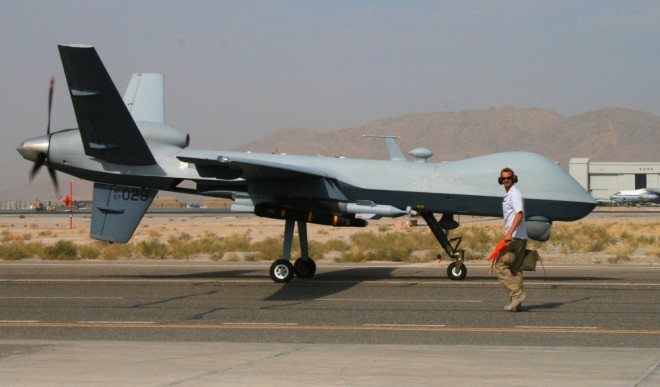
On September 30th Anwar al-Awlaki and several of his al-Qaeda colleagues stopped their pickup truck on a remote, dusty road deep inside Yemen’s interior. He can have had only a split second to realise what was about to happen. But the missile strike that killed al-Qaeda’s most effective propagandist was no real surprise. It was just the latest example of the way America’s armed Predator and Reaper drones are changing the terms of combat with the country’s enemies, leaving them able to run but with nowhere to hide.

American officers, with their passion for acronyms, prefer not to call the machine that killed al-Awlaki a drone. They have a point. In nature, drone bees are poor, useless things that produce no honey and have no sting. That hardly describes the remotely-piloted Predator MQ-1 or Reaper MQ-9 aircraft. Laden with sophisticated sensors and carrying Hellfire missiles and laser-guided bombs, they patrol the skies above Afghanistan, launch lethally accurate strikes against terrorists in the tribal areas of Pakistan, Yemen and Somalia and have helped NATO turn the tide against Muammar Qaddafi’s forces in Libya. Even calling them Unmanned Aerial Vehicles (UAVs) or Unmanned Aerial Systems (UAS) is slightly misleading. There may not be a man in the cockpit, but each Reaper, a bigger, deadlier version of the Predator, requires more than 180 people to keep it flying. A pilot is always at the controls (albeit from a base that might be 7,500 miles, or 12,000km, away); and another officer operates its sensors and cameras.

Over the past decade UAS have become the counter-terrorism weapon of choice. Since 2005 there has been a 1,200% increase in combat air patrols by UAVs. Hardly a month passes without claims that another al-Qaeda or Taliban leader has been taken out by drone-launched missiles. There are now more hours flown by America’s UAS than by its manned strike aircraft and more pilots are being trained to fly them than their manned equivalents. While taking a knife to other cherished defence programmes last year, the defence secretary, Robert Gates, went out of his way to exempt drones from future cuts.

Under Barack Obama, the frequency of drone strikes on terrorists in Pakistan’s tribal areas has risen tenfold, from one every 40 days during George Bush’s presidency to one every four. John Brennan, Mr Obama’s counter-terrorism chief, has made it clear that as America draws down its forces in Afghanistan over the next three years, there will be no let up in drone strikes, which, he claims, are partly responsible for al-Qaeda being “on the ropes”. The grim Reaper’s ability to loiter for up to 24 hours, minutely observe human activity from five miles above while transmitting “full motion video” to its controllers and strike with pinpoint accuracy has made it the essential weapon in America’s “long war”.

But does this mean that the future belongs to UAS? As military thoughts turn to the threat posed by more powerful potential adversaries than jihadist militants—a fast-emerging China, say, or a nuclear-tipped Iran—will their enthusiasm for unmanned aircraft continue unabated? Or will having a pilot in the cockpit making life and death decisions remain the least risky option for the majority of missions, as proponents of the late and wildly over-budget F-35 Joint Strike Fighter, due to enter service in 2016, claim? If the answer favours the drones, then the world may be just at the beginning of a genuine revolution in warfare. It would be a revolution dominated, at least at the start, by America, which accounts for the overwhelming majority of UAS. Other countries, though, such as Britain and Italy, have also been quick to deploy armed drones and Israel, in particular, has a thriving UAS industry, using drones in a wide variety of roles.
The balance of this lengthy but informative article explores the current crop of drones, before examining the burgeoning phenomenon of UAS in the US and beyond.... Speculation also is given to the ethics of UAS and the possibilities for future development, including almost complete automation. Definitely worth a read—take a look!

Saturday, 24 September 2011

Think Again: War

Foreign Policy magazine this month features a thought-provoking article that asks us to "Think Again" regarding war... Suggesting that "World peace could be closer than you think". Author Joshua S. Goldstein aids the process by repeating commonly-held beliefs regarding war in the modern world, before calling each immediately into question by holding up contradictory facts (excerpt follows):
"The World Is a More Violent Place Than It Used to Be."
No way. The early 21st century seems awash in wars: the conflicts in Afghanistan and Iraq, street battles in Somalia, Islamist insurgencies in Pakistan, massacres in the Congo, genocidal campaigns in Sudan. All in all, regular fighting is taking place in 18 wars around the globe today. Public opinion reflects this sense of an ever more dangerous world: One survey a few years ago found that 60 percent of Americans considered a third world war likely. Expectations for the new century were bleak even before the attacks of Sept. 11, 2001, and their bloody aftermath: Political scientist James G. Blight and former U.S. Defense Secretary Robert McNamara suggested earlier that year that we could look forward to an average of 3 million war deaths per year worldwide in the 21st century.
So far they haven't even been close. In fact, the last decade has seen fewer war deaths than any decade in the past 100 years, based on data compiled by researchers Bethany Lacina and Nils Petter Gleditsch of the Peace Research Institute Oslo. Worldwide, deaths caused directly by war-related violence in the new century have averaged about 55,000 per year, just over half of what they were in the 1990s (100,000 a year), a third of what they were during the Cold War (180,000 a year from 1950 to 1989), and a hundredth of what they were in World War II. If you factor in the growing global population, which has nearly quadrupled in the last century, the decrease is even sharper. Far from being an age of killer anarchy, the 20 years since the Cold War ended have been an era of rapid progress toward peace.

Armed conflict has declined in large part because armed conflict has fundamentally changed. Wars between big national armies all but disappeared along with the Cold War, taking with them the most horrific kinds of mass destruction. Today's asymmetrical guerrilla wars may be intractable and nasty, but they will never produce anything like the siege of Leningrad. The last conflict between two great powers, the Korean War, effectively ended nearly 60 years ago. The last sustained territorial war between two regular armies, Ethiopia and Eritrea, ended a decade ago. Even civil wars, though a persistent evil, are less common than in the past; there were about a quarter fewer in 2007 than in 1990


If the world feels like a more violent place than it actually is, that's because there's more information about wars -- not more wars themselves. Once-remote battles and war crimes now regularly make it onto our TV and computer screens, and in more or less real time. Cell-phone cameras have turned citizens into reporters in many war zones. Societal norms about what to make of this information have also changed. As Harvard University psychologist Steven Pinker has noted, "The decline of violent behavior has been paralleled by a decline in attitudes that tolerate or glorify violence," so that we see today's atrocities -- though mild by historical standards -- as "signs of how low our behavior can sink, not of how high our standards have risen."
The lengthy article proceeds to question the following assertions:
  • "America Is Fighting More Wars Than Ever." (Yes and no).
  • "War Has Gotten More Brutal for Civilians." (Hardly).
  • "Wars Will Get Worse in the Future." (Probably not).
  • "A More Democratic World Will Be a More Peaceful One." (Not necessarily).
  • "Peacekeeping Doesn't Work." (It does now).
  • "Some Conflicts Will Never End." (Never say never).
Definitely worth a read and a ponder - an opportunity to develop fresh perspective on this important topic.

Wednesday, 21 September 2011

Wired: US Establishes New Drone Bases for African Shadow Wars

Wired magazine's Danger Room reports on American preparations for the next predicted phase of "the drone wars", extending the practical reach of the US as a superpower:
Washington is quietly setting up at least two new East African drone bases, plus one on the Arabian Peninsula, to support the expanding U.S. shadow war against Islamic militants in Somalia and Yemen. An apparently new facility has been built in Ethiopia. In the island nation of Seychelles, a defunct airfield is being reactivated. A third base is being set up in or near Yemen.
The news, first reported by The Washington Post and The Wall Street Journal, should come as no surprise to close observers of America’s shadow war on the borders of the Indian Ocean. But the base expansion could be met with outrage by the people most directly affected, especially Africans themselves. For years, Washington has insisted that it wouldn’t build new bases in Africa.
The new drone facilities are a small step for a Pentagon and CIA already heavily invested in the Indian Ocean region. While mercenaries and U.S. allies“proxies” — do most of the fighting in Somalia and Yemen, American warships, aircraft and special operations forces also play an important role. U.S. Reaper or Predator drones have struck militants in Yemen at least six times total in 2010 and 2011. In Somalia, drones have attacked at least twice since 2007. U.S. forces have also hit Somalia’s al-Shabab Islamic group a total of six times, that we know of, using cruise missiles and Special Forces helicopters.
The American base in the tiny country of Djibouti, north of Somalia, provides food and fuel to the warships and serves as a launching pad for the unmanned vehicles and choppers. The Djibouti base has been around since 2001. U.S. Special Forces operated from a small base in Kenya beginning “a few years” prior to 2007, according to military consultant Tom Barnett. American commandos also launched attacks from an unspecified Ethiopian location in early 2007. The Seychelles drone base was open for business in 2009 and 2010 before temporarily shutting down.
Amid all this activity, Washington insisted it had no plans for new African bases. “I want to dispel the notion that all of a sudden America is, you know, bringing all kinds of military to Africa. It’s just simply not true,” then-President George W. Bush told reporters in Ghana in 2008. Bush was trying to reassure African audiences that the new U.S. Africa Command would not mean an expanded U.S. military presence in Africa. Africa Command kept its headquarters in Germany, but the U.S. presence expanded anyways — though many of the forces operate outside of Africa Command’s purview.

For Washington, the rationale for new bases is clear. “We do not know enough about the leaders of the Al Qaeda affiliates in Africa,” a senior U.S. official told The Wall Street Journal. “Is there a guy out there saying, ‘I am the future of Al Qaeda’? Who is the next Osama bin Laden?” If finding and killing the next bin Laden means breaking a promise over African bases, the U.S. seems content with going back on its word.

Wednesday, 1 June 2011

BBC News: US Pentagon to treat cyber-attacks as 'acts of war'

On the back of plans to beef up UK cyberwarfare preparations announced yesterday, the US Pentagon has now raised the stakes of those indulging in cyberattacks against the USA and its allies (as reported by BBC News):
The US is set to publish plans that will categorise cyber-attacks as acts of war, the Pentagon says.

In future, a US president could consider economic sanctions, cyber-retaliation or a military strike if key US computer systems were attacked, officials have said recently. The planning was given added urgency by a cyber-attack last month on the defence contractor, Lockheed Martin. A new report from the Pentagon is due out in a matter of weeks.

"A response to a cyber-incident or attack on the US would not necessarily be a cyber-response. All appropriate options would be on the table," Pentagon spokesman Col Dave Lapan told reporters on Tuesday. Col Lapan confirmed the Pentagon was drawing up a cyber defence strategy, which would be ready in two to three weeks.

Cyber-attacks from foreign nations that threaten widespread US civilian casualties, like cutting off power supplies or shutting down emergency-responder networks, could be treated as an act of aggression under the new policy. But the plan does not mention how the US may respond to cyber-attackers, such as terrorists, who are not acting for a nation state.

The Pentagon's planning follows an international strategy statement on cyber-security, issued by the White House on 16 May. The US would "respond to hostile acts in cyberspace as we would to any other threat to our country", stated the White House in plain terms.

"We reserve the right to use all necessary means - diplomatic, informational, military, and economic - as appropriate and consistent with applicable international law, in order to defend our nation, our allies, our partners and our interests."

The Wall Street Journal quoted a military official as saying: "If you shut down our power grid, maybe we will put a missile down one of your smokestacks."

White House officials said consideration of a military response to a cyber-attack would constitute a "last resort", after other efforts to deter an attack had failed, the New York Times newspaper reported.
Read the rest!

Tuesday, 31 May 2011

BBC News: UK beefs up cyber warfare plans

From BBC News today:
'Cyber' soldiers will be put alongside conventional troops as the government puts cyber attacks on an equal footing with other conflicts. The news comes as US defence firm Lockheed Martin admitted it came under a significant cyber attack last week.

The Ministry of Defence (MoD) said it will recruit hundreds of cyber experts to shore up UK defences. It is part of a £650m fund set aside by the government for dealing with cyber security.

"Our forces depend on computer networks, both in the UK and in operations around the world. But our adversaries present an advance and rapidly developing threat to these networks," said the MoD in a statement. "Future conflict will see cyber operations conducted in parallel with more conventional actions the sea, land and air operations," it added.

It will see a growing band of cyber experts deployed by the armed forces to protect vital networks.

"We expect to significantly grow the number of dedicated cyber experts in the MoD and the number will be in the hundreds but precise details are classified," said an MoD spokesman. "As with all personnel they will be expected to serve wherever necessary to do their jobs and this could be in the UK or in operational theatre," he added.

Government networks receive around 20,000 malicious e-mails each month, around 1,000 of which are deliberately targeting them. There has also been a flurry of attacks aimed atother sensitive targets in recent months.

Defence firm Lockheed Martin, which makes weapon systems that are sold around the world, was the latest to be hit. During a cyber attack last week, the firm said it took counter measures "almost immediately" and stressed that none of its programmes had been compromised. The Pentagon is now investigating the incident.
Read the rest!

Monday, 11 April 2011

Israel warns Iron Dome still at experimental stage

The Guardian, amongst many others (including BBC News, three days ago), has the story - with a video:
The initial success of Israel's Iron Dome missile-defence system has been hailed as an example of "Jewish genius" – but the army insists it is still at an experimental stage. Since 7 April the system has shot down nine rockets fired at Israel from Gaza, although it was unable to stop at least 11 others.

Boaz Ganor, the director of the Institute for Counter-Terrorism said: "It's a technical revolution that shows us what may be possible in the future. The success has been limited by the fact that we only have two batteries, but it has proven itself accurate and efficient."

The Iron Dome consists of three units: a missile-tracking radar, a control centre and a missile-firing unit. The moment a rocket is launched its trajectory is relayed to the control centre, which decides whether it will land in an open or built-up area. If the rocket threatens a densely populated area a missile is fired at it.

The world first became aware of the possibilities of missile defence during the Gulf war in 1991. US Patriot missile batteries in Israel and Saudi Arabia appeared to be successful at eliminating scud missiles fired by Iraq. In fact, the system was far less effective than it appeared and subsequent analysis estimated it had a success rate of about only 10%.

During the Iraq war in 2003 the improved Patriots proved more successful against allied aircraft than long-range rockets. Iraq did not fire any long-range rockets and the Patriots downed one British jet and one American jet, killing both crews.

Israel has long been the target of short-range rockets such as the Russian-designed Katyusha, supplied to Palestinian groups in Jordan and Lebanon in the 1970s and 80s. More recently, Hezbollah fired some 4,000 rockets at Israel in the 2006 Lebanon war, killing 44 people.

Israel has developed the Arrow long-range missile-defence system but, after its experience in 2006, the government decided to invest in the Iron Dome system instead. The cost of its development and deployment is estimated at more than £1bn, some of which will be subsidised by the US.

Critics point out that each Iron Dome missile costs about £25,000, while the rockets they eliminate are worth less than a few hundred, which could allow militants to wage economic warfare against Israel. Others suggest it would be easy to fool missile-defence systems with decoys.

"We know that terrorists are elusive and on a learning curve. There is no doubt that this success will challenge them to rethink and fine tune their tactics," said Ganor, "The whole idea of launching rockets at Israel was a response to the failure of other tactics. If Iron Dome proves to be successful, Hamas and Hezbollah will certainly try to think of new methods of attack."

Thursday, 7 April 2011

High-tech warfare: Something wrong with our **** chips today

The Economist provides a new insight into high-tech (post-modern?) warfare in this week's issue:

Kill switches are changing the conduct and politics of war
In the 1991 Gulf war Iraq’s armed forces used American-made colour photocopiers to produce their battle plans. That was a mistake. The circuitry in some of them contained concealed transmitters that revealed their position to American electronic-warfare aircraft, making bomb and missile strikes more precise. The operation, described by David Lindahl, a specialist at the Swedish Defence Research Agency, a government think-tank, highlights a secret front in high-tech warfare: turning enemy assets into liabilities.

The internet and the growing complexity of electronic circuitry have made it much easier to install what are known as “kill switches” and “back doors”, which may disable, betray or blow up the devices in which they are installed. Chips can easily contain 2 billion transistors, leaving plenty of scope to design a few that operate secretly. Testing even a handful of them for anomalies requires weeks of work.

Kill switches and other remote controls are on the minds of Western governments pondering whether to send weapons such as sophisticated anti-tank missiles, normally tightly policed, to rebels in Libya. Keeping tabs on when and where they are fired will allay fears that they could end up in terrorist hands. Such efforts would not even need to be kept secret. A former CIA official says the rebels could be told: “Look, we’re going to give you this, but we want to be able to control it.”
The 'post-modern' ability to control weapons technology by means of kill switches and other devices certainly has its advantages—as the article points out, however, there are also distinct drawbacks. Do take the time to read the entire article.

Thursday, 31 March 2011

Economist: Cry havoc! And let slip the maths of war

Warfare seems to obey mathematical rules. Whether soldiers can make use of that fact remains to be seen

The Economist today has an interesting article for those of us with a mathematical bent....
In 1948 Lewis Fry Richardson, a British scientist, published what was probably the first rigorous analysis of the statistics of war. Richardson had spent seven years gathering data on the wars waged in the century or so prior to his study. There were almost 300 of them. The list runs from conflicts that claimed a thousand or so lives to the devastation of the two world wars. But when he plotted his results, he found that these diverse events fell into a regular pattern. It was as if the chaos of war seemed to comply with some hitherto unknown law of nature.

At first glance the pattern seems obvious. Richardson found that wars with low death tolls far outnumber high-fatality conflicts. But that obvious observation conceals a precise mathematical description: the link between the severity and frequency of conflicts follows a smooth curve, known as a power law. One consequence is that extreme events such as the world wars do not appear to be anomalies. They are simply what should be expected to occur occasionally, given the frequency with which conflicts take place.

The results have fascinated mathematicians and military strategists ever since. They have also been replicated many times. But they have not had much impact on the conduct of actual wars. As a result, there is a certain “so what” quality to Richardson’s results. It is one thing to show that a pattern exists, another to do something useful with it.

In a paper currently under review at Science, however, Neil Johnson of the University of Miami in Coral Gables, Florida, and his colleagues hint at what that something useful might be. Dr Johnson’s team is one of several groups who, in previous papers, have shown that Richardson’s power law also applies to attacks by terrorists and insurgents. They and others have broadened Richardson’s scope of inquiry to include the timing of attacks, as well as the severity. This prepared the ground for the new paper, which outlines a method for forecasting the evolution of conflicts.
The article goes on to outline the theoretical basis for this approach and—although the practical application is not yet fully worked out—it nonetheless makes very interesting reading and raises some thought-provoking questions. How does this fit into the Realist / Liberal interpretations of conflict and human nature, for example?

Tuesday, 22 March 2011

Wired: Drones’ Suicidal Cousins Lead Libya Attack

Wired Magazine's Danger Room brings news of the active use of a new generation of cruise missile:
When the U.S. military wanted to take out Moammar Gadhafi’s air defense systems, it unleashed a barrage of 122 Tomahawk cruise missiles. But these munitions aren’t like most others in the American arsenal.

Smart, maneuverable, able to see its surroundings and shift to new targets in mid-flight, the newest Tomahawks are closer to the unmanned planes flying over Afghanistan than to the weapons they fire. In some ways, the Tomahawk is the drone’s suicidal cousin: a robotic aircraft, packed with explosives, that has no intention of ever coming home.
The article's worth a read.... The current crop of missiles are reviewed as to capability, with a nod to the past history of the cruise missile. Most interesting is news of yet another generation of cruise missile, one that will certainly add to the impression of a 'post-modern' phase of warfare:
... if an experimental Air Force program pans out. ... The X-51a aircraft is designed to test technologies for a next-gen cruise missile — one that would fly at six times the speed of sound. Which means tomorrow’s cruise missiles could be like suicidal, smart, and more than eight times faster than today’s Tomahawks.

Monday, 21 March 2011

Drones 'winning' war against al-Qaeda, says ex-CIA head

BBC News Online has a summary of opinion expressed in tonight's second part of BBC2's The Secret War on Terror (catch up on iPlayer):
More than 40 people were killed in Pakistan last week in a US drone attack near the Afghan border. The use of unmanned drones have always been controversial, but ex-CIA director Michael Hayden says they are winning the war.

Ten years on from 9/11, al-Qaeda appears to be on the back foot. One of the main reasons is that its leadership no longer enjoys untouchable sanctuary in the tribal areas of Pakistan where for many years it has been able to plot and train its recruits.

The reason? Pilotless American drone aircraft with a payload of deadly Hellfire missiles, guided to their targets by remote control from thousands of miles away in the American desert. Not for nothing are the drones known as "Predators".
The program explores both the effectiveness and the controversial legality of this example of 'new warfare'.... Whatever the various opinions, the former head of the CIA is convinced:
"It has been a very strong significant force in making the al-Qaeda senior leadership spend most of their waking moments worrying about their survival, rather than threatening yours or mine. And that is a war-winning effort," he told me.
 The program goes on to discuss other opinions regarding the prospect of victory in the 'war against terror', not least that of retired MI5 Director, Baroness Manningham-Buller:
At the end of the interview, given her long experience in fighting terrorism in Northern Ireland and her intimate knowledge of the secret talks between MI5 and the IRA, I asked her if we should talk to al-Qaeda as we had once talked to the IRA.

"It's always better to talk to the people who are attacking you than attacking them, if you can.Her reply took me by surprise. "I would hope that people are trying to do so," she said. I don't know whether they are, but I would hope that people are trying to reach out to the Taliban, to people on the edges of al-Qaeda to talk to them."

I then asked her if she thought that al-Qaeda would listen.

"I don't know," she said. "Doesn't mean to say it's not worth trying."
Do read the whole article - do watch the program!

Tuesday, 8 March 2011

Former Cold Warriors: Deterrence in the Age of Nuclear Proliferation

Just yesterday, Martin Hellman announced the publication of an important position paper against nuclear proliferation with the following words:
George Shultz served as President Reagan's Secretary of State, and Bill Perry as President Clinton's Secretary of Defense. Henry Kissinger was National Security Advisor and Secretary of State to both President Nixon and Ford. Sam Nunn was Chair of the Senate Armed Services Committee for eight years. Their key roles in the Cold War has led many to call them 'Cold Warriors.' That status makes their recent, repeated calls for fundamentally re-examining our nuclear posture all the more noteworthy. Their most recent attempt to awaken society to the unacceptable risk posed by nuclear weapons is an Op-Ed in today's Wall Street Journal titled Deterrence in the Age of Nuclear Proliferation. [subscription-free link]
With such an authorship, this short document is definitely worth a read!

Friday, 11 February 2011

LSE Video Presentation: Living in the Second Nuclear Age

When the Cold War ended, the threat of an all-out war between the superpowers ended with it. Nuclear war apparently went away. But while the political games changed, the nuclear arsenal that had done so much to keep the Cold War from ever turning hot remained very much in place.

In this film (released back in December 2009), renowned LSE historian of the Cold War Professor Arne Westad explains that not only have hopes for a dismantling of the weapons stockpile failed to be realised, but that the period since the end of the Cold War has seen proliferation occur at such a pace that ours is now referred to as "The Second Nuclear Age." Professor Westad also talks of his prevailing hope for a world free of nuclear weapons.

Monday, 7 February 2011

Wired: One in 50 Troops in Afghanistan Is a Robot

Wired Magazine's Danger Room has an interesting article about the use of robotics by US Forces in Afghanistan—another aspect of the changing nature of warfare:
There are more than 2,000 ground robots fighting alongside flesh-and-blood forces in Afghanistan, according to Lt. Col. Dave Thompson, the Marine Corps’ top robot-handler. If his figures are right, it means one in 50 U.S. troops in Afghanistan isn’t even a human being. And America’s swelling ranks of ground-bot warriors are being used in new, unexpected, life-saving ways.

But there’s one small problem: however numerous, these rolling and crawling bots are still pretty stupid. And there’s not much hope they’ll get any smarter anytime soon.

Ground bots first made inroads among bomb-disposal units. The human bomb-techs could take cover and steer in a remote-controlled Talon or PackBot to disable a dangerous explosive device. But a third of the 1,400 fresh ground bots deployed to Afghanistan in 2009 and 2010 weren’t for EOD, Thompson pointed out during a presentation at a Washington, D.C. trade show “Robots are not just for explosive ordnance disposal teams anymore … They [ground troops] are using them in ways we never expected.”
 Read the whole thing for useful examples of changing methods of fighting modern wars.

Saturday, 5 February 2011

Hague: Chinese cyber-spies penetrate Foreign Office computers

The Guardian newspaper last night detailed the announcement to a Munich security conference by UK Foreign Secretary William Hague that an attack on British interests was recently repelled from "a hostile state intelligence agency":
China has penetrated the Foreign Office's internal communications in the most audacious example yet of the growing threat posed by state-sponsored cyber-attacks, it emerged tonight.

William Hague told a security conference in Munich that the FO repelled the attack last month from "a hostile state intelligence agency". Although the foreign secretary did not name the country behind the attacks, intelligence sources familiar with the incidents made it clear he was referring to China. The sources did not want to be identified because of the sensitive nature of the issue.

In his speech Hague was reflecting growing anger and concern within the government about the increasing threat posed by cyber-espionage – states, as well as individuals, using cyberspace to steal defence, diplomatic and commercial secrets.

"It is a new development. The UK is prepared to admit the attacks were state-backed," said Alexander Neill, head of the Asia programme at the Royal United Services Institute thinktank.

The foreign secretary said the FO attack came in the form of an email sent to three of his staff "which claimed to be about a forthcoming visit to the region and looked quite innocent". In fact it was from a hostile state intelligence agency and contained computer code embedded in the attached document that would have attacked their machine. Luckily, our systems identified it and stopped it from ever reaching my staff," Hague said.
 As also outlined by Hague, this attack is but the latest of three recent attempts to penetrate UK security in cyberspace... The opinion of the Defence Chiefs regarding these developments is clear:
General Sir David Richards, chief of the defence staff, last month said the UK needed its own Cyber Command, similar to that set by by the US defence department. He said that the advance of cyber technology would lead to a "cultural change" in warfare which the UK must be prepared for."We must learn to defend, delay, attack and manoeuvre in cyberspace, just as we might on the land, sea or air and all together at the same time".

Thursday, 27 January 2011

Wired: Stats Back Al-Qaida Claim of Drone Pain

Wired Magazine's Danger Room today delivers reports of statistical studies—combined with anecdotal evidence gathered from intelligence—that suggest that America's "drone war" against al-Qaida in Afghanistan and North-West Pakistan is starting to see some (modest) results:
Is the U.S. drone war in Pakistan putting the squeeze on al-Qaida’s safe havens? It’s not a question that lends itself to easy answers, given the difficulties of reporting from the Federally Administered Tribal Areas where al-Qaida’s top leaders are believed to be. But a new statistical analysis by researchers at Harvard finds that the deadly robots overhead are reaping modest “counterterrorism dividends” — something that al-Qaida itself is complaining about.

Ustadh Ahmad Farooq, a leading al-Qaida propagandist in Pakistan, says in a new audio message that the terrorist network is “losing people” and “facing shortages of resources” in the area, thanks in large part to the escalated U.S. drone campaign. And he indicates the safe havens aren’t as safe as they once were.

“There were many areas where we once had freedom, but now they have been lost,” Farooq laments in a January 23 audio message obtained by the terror-trackers at the SITE Intelligence Group. “Our land is shrinking and drones are flying in the sky.”
 Make an effort to read the rest of the article.

Wednesday, 26 January 2011

Economist Audio Slideshow: Rape, A Weapon of War

The Economist features a newly-added audio slideshow in which photojournalist Marcus Bleasdale talks about a selection of his images chronicling the impact of rape in war-torn areas of Africa:

Tuesday, 18 January 2011

Wired: All-Seeing Blimp Could Be Afghanistan’s Biggest Brain

Wired: Danger Room brings news of a new high-flying (floating?) weapon brought to bear by the Americans in Afghanistan...
Come this fall, there will be a new and extremely powerful supercomputer in Afghanistan. But it won’t be in Dave Petraeus’ headquarters in Kabul or at some three-letter agency’s operations center in Kandahar. It’ll be floating 20,000 feet above the warzone, aboard a giant spy blimp that watches and listens to everything for miles around.
Amazing concept and technology - a new frontier in warfare. Read the whole thing.

Sunday, 16 January 2011

Guardian: Attack of the drones

Unmanned aircraft are now a vital tool in war zones, but our skies could soon be buzzing with spy planes that feed information back to the police – and even the paparazzi... The Guardian reports on the latest developments in remote controlled warfare and surveillance:

http://www.guardian.co.uk/uk/2011/jan/16/drones-unmanned-aircraft

Saturday, 15 January 2011

Wired: Old school jet retooled to slay stealth fighters

More on that story from 3 weeks ago about the flight of the new Chinese stealth fighter..... Now, according to Wired: Danger Room we have the re-use of a 20 year old American classic to counter the new threat:

http://www.wired.com/dangerroom/2011/01/old-school-jet/


Things don't stand still long on the military front! (Makes you think that US intelligence must already have known about the J-20....)

Thursday, 13 January 2011

Economist: War's overlooked victims

Violence against women - Rape is horrifyingly widespread in conflicts all around the world

The Economist today has a wide-ranging article examining how rape is frequently used as a weapon of war in conflicts around the world.

There's nothing completely new in this, of course - rape has been a feature of war for millennia. Several current conflicts, however, have made rape seemingly routine, perhaps supporting Mary Kaldor's characterisation of "new wars" that are primarily civil in nature and are frequently based on identity (ethnic nationalism or religious radicalism). A further feature of these wars, usually occurring against a back drop of state fragmentation and failure, is the change in legal status of combatants and a new level of atrocities as war is waged ‘among the people’. An important aspect in this is the involvement and the effect on both women and children.

Uncomfortable reading, but worth doing nonetheless. Read the whole thing.