Wednesday, 21 September 2011

Wired: US Establishes New Drone Bases for African Shadow Wars

Wired magazine's Danger Room reports on American preparations for the next predicted phase of "the drone wars", extending the practical reach of the US as a superpower:
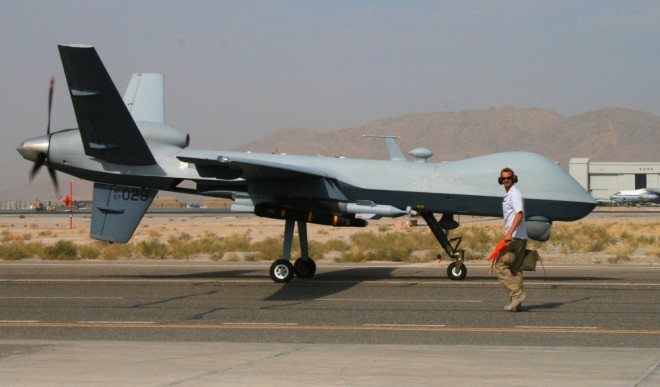
Washington is quietly setting up at least two new East African drone bases, plus one on the Arabian Peninsula, to support the expanding U.S. shadow war against Islamic militants in Somalia and Yemen. An apparently new facility has been built in Ethiopia. In the island nation of Seychelles, a defunct airfield is being reactivated. A third base is being set up in or near Yemen.
The news, first reported by The Washington Post and The Wall Street Journal, should come as no surprise to close observers of America’s shadow war on the borders of the Indian Ocean. But the base expansion could be met with outrage by the people most directly affected, especially Africans themselves. For years, Washington has insisted that it wouldn’t build new bases in Africa.
The new drone facilities are a small step for a Pentagon and CIA already heavily invested in the Indian Ocean region. While mercenaries and U.S. allies“proxies” — do most of the fighting in Somalia and Yemen, American warships, aircraft and special operations forces also play an important role. U.S. Reaper or Predator drones have struck militants in Yemen at least six times total in 2010 and 2011. In Somalia, drones have attacked at least twice since 2007. U.S. forces have also hit Somalia’s al-Shabab Islamic group a total of six times, that we know of, using cruise missiles and Special Forces helicopters.
The American base in the tiny country of Djibouti, north of Somalia, provides food and fuel to the warships and serves as a launching pad for the unmanned vehicles and choppers. The Djibouti base has been around since 2001. U.S. Special Forces operated from a small base in Kenya beginning “a few years” prior to 2007, according to military consultant Tom Barnett. American commandos also launched attacks from an unspecified Ethiopian location in early 2007. The Seychelles drone base was open for business in 2009 and 2010 before temporarily shutting down.
Amid all this activity, Washington insisted it had no plans for new African bases. “I want to dispel the notion that all of a sudden America is, you know, bringing all kinds of military to Africa. It’s just simply not true,” then-President George W. Bush told reporters in Ghana in 2008. Bush was trying to reassure African audiences that the new U.S. Africa Command would not mean an expanded U.S. military presence in Africa. Africa Command kept its headquarters in Germany, but the U.S. presence expanded anyways — though many of the forces operate outside of Africa Command’s purview.

For Washington, the rationale for new bases is clear. “We do not know enough about the leaders of the Al Qaeda affiliates in Africa,” a senior U.S. official told The Wall Street Journal. “Is there a guy out there saying, ‘I am the future of Al Qaeda’? Who is the next Osama bin Laden?” If finding and killing the next bin Laden means breaking a promise over African bases, the U.S. seems content with going back on its word.

Monday, 19 September 2011

What happens if the population forecasts are wrong?

Carl Haub for Yale Environment 360, part of the Guardian Environment Network poses a powerful question, as syndicated in today's Guardian newspaper (full article follows, check original site for reader comments):
In a mere half-century, the number of people on the planet has soared from 3 billion to 7 billion, placing us squarely in the midst of the most rapid expansion of world population in our 50,000-year history — and placing ever-growing pressure on the Earth and its resources.
But that is the past. What of the future? Leading demographers, including those at the United Nations and the U.S. Census Bureau, are projecting that world population will peak at 9.5 billion to 10 billion later this century and then gradually decline as poorer countries develop. But what if those projections are too optimistic? What if population continues to soar, as it has in recent decades, and the world becomes home to 12 billion or even 16 billion people by 2100, as a high-end UN estimate has projected? Such an outcome would clearly have enormous social and environmental implications, including placing enormous stress on the world's food and water resources, spurring further loss of wild lands and biodiversity, and hastening the degradation of the natural systems that support life on Earth.
It is customary in the popular media and in many journal articles to cite a projected population figure as if it were a given, a figure so certain that it could virtually be used for long-range planning purposes. But we must carefully examine the assumptions behind such projections. And forecasts that population is going to level off or decline this century have been based on the assumption that the developing world will necessarily follow the path of the industrialized world. That is far from a sure bet.
Eyeing the future, conservationists have clung to the notion that population will peak and then start to decline later this century. Renowned evolutionary biologist Edward O. Wilson has propounded what he terms the bottleneck theory: that maximum pressure on the natural world will occur this century as human population peaks, after which a declining human population will supposedly ease that pressure. The goal of conservation is therefore to help as much of nature as possible squeeze through this population bottleneck. But what if there is no bottleneck, but rather a long tunnel where the human species continues to multiply?
Population projections most often use a pattern of demographic change called the demographic transition. This model is based on the way in which high birth and death rates changed over the centuries in Europe, declining to the low birth and death rates of today. Thus, projections assume that the European experience will be replicated in developing countries. These projections take for granted three key things about fertility in developing countries. First, that it will continue to decline where it has begun to decline, and will begin to decline where it has not. Second, that the decline will be smooth and uninterrupted. And, finally, that it will decline to two children or less per woman.
These are levels now found in Europe and North America. But will such low levels find favor in the Nigerias, Pakistans, and Zambias of this world? The desire for more than two children — often many more than two — will remain an obstacle and will challenge assumptions that world population will level off or decline.
In quite a few developing countries, birth rates are declining significantly. But in others they are not. In Jordan, for example, the fertility rate still hovers around 4 children per woman. Indonesia was a country that was widely acknowledged for its innovative and steadfastly pursued family planning program in the 1980s, when its total fertility rate fell to 3 children per woman. It has been hovering for some time around 2.5. In a recent survey, about 30 percent of women with 2 living children said that they wanted another child. That figure was 35 percent for their husbands.
Sub-Saharan Africa (SSA) is the region that now causes the most worry. It remains in a virtual pre-industrial condition, demographically speaking, with high fertility and rather high mortality. The UN projects that fertility will decline from a high level of 6 children per woman around 1990 and reach about 3 children per woman by 2050. Many sub-Saharan African countries have seen some decline, and today the average fertility rate is 5.2 children per woman. Should the UN's assumptions prove correct, sub-Saharan Africa's population would still rise from 880 million today to 2 billion in 2050.
Countries such as Congo, Kenya, Madagascar, and Rwanda have identified rapid population growth as a problem and committed sufficient resources to address it. Yet their fertility rates remain at 4.6 to 4.7 children per woman, and a future halt in fertility decline in those countries would surprise no one. But most future population projections assume a continuing decline.
Often fertility rates might decline from a higher level and then "stall" for a time, not continuing their downward trajectories to the two-child family, resulting in a higher-than-projected population. In sub-Saharan Africa, this has happened in Nigeria, where the fertility rate has stalled at about 5.7, and in Ghana, where the fertility rate is 4.1 and apparently resuming a slow decline. Very recent surveys have shown that fertility decline in Senegal has likely stalled at 5.0 children and has risen somewhat to 4.1 in Zimbabwe. Clearly, not all countries will see a continuous decline in fertility rates, and some have barely begun to drop, meaning that projected population sizes will turn out to be too low.
Fertility rates are lowest among educated, urban women who account for much of the initial decrease. What will it take to reach large, often inaccessible rural populations, whose desire to limit family size is frequently quite limited and whose "ideal" number of children is quite high? Challenges include: the logistical task of providing reproductive health services to women; informing them of their ability to limit their number of children and to space births over at least two years; low levels of literacy; the value husbands place on large families; and securing funding for family planning programs.
India provides another cautionary tale. The country is often hailed as an emerging economic power, yet 930 million people — three-quarters of India's population — live on less than $2 per day. Some advanced Indian states, such as Kerala and Tamil Nadu, have excellent family planning programs and fertility rates of 1.8 children per woman, which will lead to declining populations in those states. But some of India's poorest and most populous states — Bihar, Madhya Pradesh, Rajasthan, Uttar Pradesh — have total fertility rates ranging from 3.3 to 3.9. The Indian example illustrates an important trend: that the challenge of soaring populations will increasingly be concentrated in the poorest countries, and in the poorest regions of nations such as India.
The real possibility of fertility decline stopping before the two-children level is reached requires demographers, policy makers, and environmentalists to seriously consider that population growth in the coming century will come in at the high end of demographic projections. The UN's middle-of-the-road assumption for sub-Saharan Africa — that fertility rates will drop to 3.0 and population reach 2 billion by 2050 — seem unrealistically low to me. More likely is the UN's high-end projection that sub-Saharan Africa's population will climb to 2.2 billion by 2050 and then continue to 4.8 billion by 2100. The dire consequences of such an increase are difficult to ponder. If sub-Saharan Africa is having trouble feeding and providing water to 880 million people today, what will the region be like in 90 years if the population increases five-fold — particularly if, as projected, temperatures rise by 2 to 3 degrees C, worsening droughts?
Many factors may arise to cause fertility rates to drop in countries where the decline has lagged. A rising age at marriage, perhaps resulting from increased education of females and from their increased autonomy; rising expectations among parents that their children can have a better life; decreasing availability of land, forcing migration to cities to seek some source of income; real commitment from governments to provide family planning services and the funds to do so. The list goes on.
But we must facts. The assumption that all developing countries will see their birth rates decline to the low levels now prevalent in Europe is very far from certain. We can also expect the large majority of population growth to be in countries and areas with the highest poverty and lowest levels of education. Today, the challenge to improve living conditions is often not being met, even as the numbers in need continue to grow.
As populations continue to rise rapidly in these areas, the ability to supply clean water for drinking and sustainable water for agriculture, to provide the most basic health services, and to avoid deforestation and profound environmental consequences, lies in the balance.

Thursday, 8 September 2011

Al-Qaida: spent force or spark for future generations of Islamic militants?

Jason Burke, Guardian correspondent whose book The 9/11 Wars comes out this month, writes in today's edition about the dangers of complacency vis à vis al-Qaida:
It is the biggest terrorism trial ever staged in Saudi Arabia. In the dock are nearly 100 men and women accused of attacks in the country. The testimony describes bloody assaults on compounds full of expatriates and bombings of government buildings. The accused will almost certainly be found guilty and many will be executed.

But in many respects this feels like a court case from another era. The current trial relates to episodes from 2003 and 2004, which might just turn out to be the heyday of the Islamist terrorism phenomenon known as al-Qaida.

"In the last two or three years al-Qaida in Saudi Arabia is dying," said Dr Abdul Rahman al-Hadlaq, senior adviser to the ministry of the interior in Riyadh. The most recent terrorist incident in the kingdom was several months ago: a checkpoint shooting involving a militant returned from Guantánamo Bay.
Osama bin Laden's death impacted on al-Qaida's power and influence around the world, but it was already waning, say security experts.

Around the world, the assessments of most counter-terrorist officials about the health of violent Islamic extremism in the areas they watch are close to that of al-Hadlaq. So far, this year has seen less terrorist violence associated with al-Qaida than any other since the millennium, arguably the late 1990s. Despite the obvious significance of the date, "there have been no credible … threats against the United States yet ahead of the 10th anniversary of the September 11 attacks," the US homeland security secretary, Janet Napolitano, recently told reporters.

In Afghanistan, US and other western intelligence officials told the Guardian there were only around 100 al-Qaida fighters and of those only "a handful" posed an international threat. There is a residual presence in parts of north Africa but not one that menaces Europe, according to France's top counter-terrorist judge.

In Iraq, al-Qaida is a shadow of its former self and resurgent groups in Yemen and Somalia, only tenuously linked to the senior leadership based in Pakistan, cannot make up for the organisation's loss of capacity elsewhere, analysts say. "The CT [counter terrorist] specialists are worried but neither Yemen nor east Africa are a strategic threat," said one western security official. Islamic extremists have been marginal to the events of the Arab spring, many point out. And of course Osama bin Laden, the founder of al-Qaida and its leader, is now dead, killed in an American special forces raid on a compound in Pakistan in May.

"Al-Qaida has been hollowed out," said a British security source. "Of the 10 top people we were most interested in a few years ago, only one is still alive. Maybe we will look back at the first decade of this century as an aberration when a small number of people threatened a superpower."

Yet after many years of officials and politicians stressing the threats posed by al-Qaida – often represented as a global terror network with the ability to launch devastating strikes almost at will – this declaration of victory seems rather sudden. So what is the true picture?

Life for militants

In late June last year a German jihadi volunteer called Rami Makanesi was detained by Pakistani intelligence services at a checkpoint on the edge of the semi-autonomous tribal zones near the border with Afghanistan. Under interrogation Makanesi, from Frankfurt, was to provide the most detailed recent account of life for al-Qaida militants in their Pakistani stronghold. Analysts have long spoken of al-Qaida as divided into three parts: central or senior leadership, affiliates or networked groups and the ideology. What was clear from Makanesi's testimony, obtained by the Guardian, is that "al-Qaida central" has been under pressure for some time.

The overweight former heavy drug user described a world of splintered factions in constant fear of their communications being intercepted by spies. Training was rushed, carried out indoors or in villages for fear of attacks by the unmanned drones which killed around 25 of his associates. Makanesi's own freelance attempts to travel to Afghanistan to fight were unsuccessful. He had to buy his own gun and pay his own rent, confirming reports that al-Qaida is short of funds.

Makanesi's description, intelligence officials said, matched their understanding of al-Qaida's existence in the tribal zones. A small number of key leaders – around a dozen are believed by analysts to have attended a meeting to ratify the succession of Ayman al-Zawahiri as head of the group – spend as much time avoiding missile strikes and betrayal as plotting operations.

According to US officials, material seized from the compound where Bin Laden was killed in May suggests that the attacks in London in 2005 and the thwarted "airlines plot" of 2006 were the last over which he had close control of operational details. From that date on, apparently, his role was restricted to broad strategic direction. In the second half of the last decade al-Qaida turned into an umbrella term for a range of militant groups. This network of affiliates has also suffered in recent years.

By 2006, when their leader Abu Musab al-Zarqawi was killed, the al-Qaida affiliate in Iraq was in deep trouble. In recent years, al-Qaida offshoots from Morocco to the Philippines, some formally linked to the group, others simply inspired by it, have been eliminated or put under enormous pressure.

That pressure is continuing, says Philip Mudd, a senior intelligence adviser at the FBI until 2010. "The Europeans are still pretty serious, the Saudis have done well," he said. "The Indonesians have done better than many thought they would." One of the newest affiliates – al-Qaida in the Maghreb – has proved incapable of confronting even local security forces in Algeria let alone projecting a broader threat. According to Mudd, the "operational and ideological momentum" which lay with the militants in the middle years of the last decade now lies with those fighting them.

Falling support for al-Qaida

Peter Bergen, the American author and al-Qaida expert, points to the series of polls showing the degree to which support for Bin Laden, the group and their methodology, always far from unanimous, was falling rapidly in key countries such as Egypt, Jordan, Indonesia and elsewhere even before the events of this year in the Arab world. "Al-Qaida's leaders, footsoldiers, ideas were all totally absent from the Arab spring," he said. "When al-Zawahiri issued a statement on what was going on, it was totally ignored." Bergen said.

In Bin Laden's native Saudi Arabia, officials pointed out that support fell away rapidly after the first wave of terrorist attacks in the kingdom in 2003. In Afghanistan, relations between the Taliban, committed largely to local goals, and international militants with a global agenda remain tense and complex.

In Europe too militants have become increasingly marginalised. Once there were scores of young Britons seeking training or combat experience alongside the Taliban each year. Now there are no more than a dozen or so, UK security sources claim. Officials at MI5 say their new tactic of early "interdiction" of any threat works well enough for things to look "boring".

"We will have al-Qaida and al-Qaida-related violence for some time to come," said Nigel Inkster, former deputy director of MI6. "But the tide has turned. Bin Laden's ideas of setting the Muslim world ablaze and sparking a global insurgency have been and gone."

However, some warn against the new confidence of security officials and politicians. "There is a narrative of victory that does not make for good analysis," said Leah Jewell, who tracked Islamic militancy for the Australian police. Mudd, meanwhile, is concerned that overly optimistic assessments could lead to a lack of focus. "The guy is on the floor and we need to kick him in the face," he said. "This is a long campaign."

Others suggest there is a risk of the same analytic failure that has crippled attempts to deal with the problem of Islamic militancy since 2001: the reduction of a broad phenomenon with roots in political, religious, social and cultural factors in the Islamic world to the activity of a person or group.

Bin Laden's project was to unite and focus the disparate strands of radical Islamic militancy. In this he was partially and temporarily successful. But the last decade has seen a steady move away from the highly organised, carefully planned strikes involving dozens of attackers towards chaotic, fragmented and diverse violent activism. The European Union's criminal intelligence agency estimates that less than a third of those arrested for Islamist terrorism in 2010 in Europe were linked to a specific group.

Michael Leiter, director of the US National Counter-terrorism Centre, described the numerous plots in America last year as "unrelated operationally but … indicative of a collective subculture and a common cause that rallies independent extremists to want to attack the homeland". In India, recent attacks are believed to be the work of "homegrown" militants without external links. One incident earlier this year – the bombing of a cafe in Marrakech, Morocco – was disowned by al-Qaida itself. An autonomous group of militants claiming allegiance to the organisation appears responsible.

Counter-terrorism strategies now largely reflect this new reality, even if the language used by officials and politicians in public sometimes does not. These days western intelligence services favour analysis of networks over building pictures of traditional hierarchies, while "profiling" based on generalisations has been replaced by a "granular" approach. One element emerging from research by several services has been the importance of family ties in the process of radicalisation around the world.

Concern about jihadi families

Evidence of the ease with which groups of close relatives appear to have been drawn into violent militancy from the ongoing trials in Saudi Arabia has shocked local officials. Such ties have also been identified by US intelligence analysts in Iraq. In the UK, security officials are concerned about "jihadi families", particularly the potential of the children of militants to turn to violence. In Algeria last month, the 23-year-old son of a former senior Islamist was killed by security forces as he drove a car laden with explosives. Suspects arrested in Britain in the last year have been in their late teens. For them the 9/11 attacks are little more than a childhood memory.

There are concerns too about the threat from militants imprisoned after 2001 and now due for release. "Very few appear very repentant," said Inkster.

More than 20 years after the foundation of al-Qaida it appears the group is fading from the world scene. "With hindsight 9/11 looks like the climax of something, not the beginning," said Bergen. But much of the destructive energy harnessed by the group remains, experts say, simply without the focus that Bin Laden and his associates provided. There are too many variables to make any certain predictions but over coming years a new focus could emerge. This could be the result of anarchy in a particular region, state support, the rise of a new charismatic leader or as a consequence of overreaction by western powers to a successful terrorist strike that many officials say is "inevitable".

Noman Benotman, an analyst and former senior Libyan militant who knew Bin Laden, is concerned that expectations raised by the Arab spring will not be met, creating a fertile ground for extremism. What happens in Libya, Iraq, and Afghanistan will also be important. So will be the evolution of groups such as Lashkar-e-Toiba in Pakistan.

The radicalisation and polarisation that came from the wars of the last decade are further factors, along with the complicated roots of contemporary Islamic militancy. "I hope I am wrong but I don't think all of this is finished," Benotman said.

Wednesday, 7 September 2011

Slate Magazine: The 9/11 Report - A Graphic Adaptation

Slate magazine has issued reminders this week of its 2006 publication of a graphic adaptation of the wide-ranging 9/11 Report conducted by the US National Commission on Terrorist Attacks upon the United States—a useful resource as we approach the 10th anniversary of the 2001 attacks.


Sunday, 4 September 2011

The Worst Mistake America Made After 9/11

Anne Appelbaum in a thought-provoking article in Slate magazine today believes that "focusing too much on the war on terror undermined our (the American) economy and global power" (some excerpts):
In the wake of al-Qaida's attack on New York and Washington, an organizing principle suddenly presented itself. Like the Cold War, the new "war on terror," as it instantly became known, clearly defined America's friends, enemies, and priorities. Like the Cold War, the war on terror appealed both to American idealism and to American realism. We were fighting genuine bad guys, but the destruction of al-Qaida also lay clearly within the sphere of our national interests. The speed with which we all adopted this new paradigm was impressive, if somewhat alarming. At the time, I marveled at the neatness and cleanliness of this New New World Order and observed "how like an academic article everything suddenly appears to be."

The events of 9/11 reverberated through many spheres of American life but nowhere more profoundly than in American policy toward the outside world. Slowly, the supertanker that is the American foreign and defense establishment turned itself around, creaking and groaning, as Americans prepared to face new enemies. During the subsequent decade, we created a vast new security bureaucracy, encompassing some 1,200 government organizations, 1,900 companies, and 854,000 people with security clearances, according to a Washington Post investigation carried out last year. We launched two wars, in Afghanistan and Iraq. We organized counterterrorism operations in far-flung places such as the Philippines and Yemen, changed the culture of our military and reoriented our foreign policy. We sharpened our focus on al-Qaida and its imitators. And we spent, according to one estimate, $3 trillion.

And we were, in the terms defined by the war on terror, successful: Ten years after 9/11, al-Qaida is in profound disarray. Osama bin Laden is dead. Fanatical Islam is on the decline. Our military remains the most sophisticated and experienced in the world. And yet, 10 years after 9/11, it's also clear that the war on terror was far too narrow a prism through which to see the entire planet. And the price we paid to fight it was far too high.

In our single-minded focus on Islamic fanaticism, we missed, for example, the transformation of China from a commercial power into an ambitious political power. We failed to appreciate the significance of economic growth in China's neighborhood, too. When President George W. Bush traveled in Asia in the wake of 9/11, he spoke to his Malaysian and Indonesia interlocutors about their resident terrorist cells. His Chinese colleagues, meanwhile, talked business and trade.
China is not the only area on which American lost focus, according to Appelbaum—she also cites problems with Russia, with Mexican immigration, with domestic investment, that might not have been the problems they currently are with decreased focus on a war against terror. An interesting perspective vis à vis America's position as still the sole superpower... Do take a look!
Intervention, Libya, and the Future of Sovereignty

Anne-Marie Slaughter, the Bert G. Kerstetter '66 University Professor of Politics and International Affairs at Princeton University, previously the director of policy planning for the U.S. State Department and dean of Princeton's Woodrow Wilson School of Public and International Affairs, writes today in The Atlantic regarding the significance of NATO's current intervention. Professor Slaughter (great name!) believes that "International law -- and the governments that bring it into being -- are (in) the process of redefining the definition of sovereignty"....

BBC News: 9/11 Timeline - the Story of the Day

BBC News this morning has placed a useful timeline summary of the events—almost 10 years ago now—of September 11th, 2001.


There's maps showing the tracks of the hijacked aircraft, as well as convenient links to short snippets of video footage from the day. Overall, a great resource that may aid understanding of the most audacious terrorist attack in recent history.

Monday, 29 August 2011

CFR Backgrounder: Targeted Killings

The Council for Foreign Relations, a US foreign policy think tank, has published a useful 'backgrounder' article on the phenomenon of "targeted killings" (i.e. assassinations) as currently practised by the US against its enemies abroad. The following sub-topics are discussed:
  • What are targeted killings?
  • What are the legal considerations surrounding U.S. targeted killings?
  • What methods of targeted killing does the United States employ?
  • What are the political implications of U.S. targeted killing?
  • What is the future of targeted killings?
Definitely worth a read as background to US counter-terrorism measures. Take a look!

Friday, 26 August 2011

Nature: El Niño tied to civil conflicts in tropical countries

An interesting summary of recent research published in the journal Nature has appeared today in an article inside Ars Technica Nobel Intent section:
Political conflicts are extremely complex, and we almost never understand all the factors that are involved in their timing, the course they take, and their eventual outcome. In this week’s Nature, a paper suggests a new variable to consider: the climate. According to researchers from Columbia and Princeton, there is good evidence that global climate variations can play a role in the onset of civil conflicts.

The El Niño-Southern Oscillation cycle, known as ENSO, is a climatic pattern that repeats about every 5 years. Variations in water temperatures and air pressure in the Pacific Ocean cause El Niño years to be warm and dry, while La Niña years are cooler and wetter. These oscillations are felt most strongly in tropical countries, while mid-latitude areas are much less affected.

The authors of the study hypothesized that these cycles might play a role in the onset of civil conflicts. Although some research has been done on the correlation between climate and conflict, methodological difficulties and inconclusive results have caused lots of confusion. Climate studies are difficult because there is no Earth we can control to experiment with; we are stuck examining global patterns with few controls. However, in this study, ENSO provides a convenient experimental setup: volatile El Niño years provide a “treatment” group, while calmer La Niña years serve as a control.

175 countries were included in the dataset, including 93 tropical countries that are highly prone to the effects of El Niño and 82 other countries that are weakly affected by ENSO. Countries were classified as experiencing "conflict onset" in a given year if more than 25 people had died as a direct result of a new political dispute between two groups. Conflicts from 1950 to 2004 were included. Then the researchers calculated the annual conflict risk (or ACR) for both the tropical countries and the weakly affected countries. The ACR is the probability that a randomly selected country from the group experienced conflict onset in a particular year.

For the countries that aren’t highly affected by ENSO, such as Greece, Afghanistan, and Sweden, the ACR was about 2 percent in both El Niño and La Niña years, indicating that these climate cycles are unlikely to affect civil conflict in these countries. However, the ACR for tropical countries such as Australia, Sudan, and Trinidad doubled during El Niño years, increasing from 3 percent to 6 percent. From their analyses, the researchers concluded that the ENSO cycle may have affected 21 percent of civil conflicts since 1950.

The results are remarkably robust; the researchers repeated the analysis with various types of statistical models and with different ENSO indices, and their conclusions remained the same. Furthermore, the results held up even when high-conflict countries were excluded from the dataset, and when other variables, such as a country's age structure, income growth, and agricultural reliance, were included in the analyses.

Two additional findings were particularly intriguing. Many of the conflicts affected by ENSO are particularly deadly recurring conflicts. By changing the requirement for the length of "peaceful periods" between conflicts, the researchers found that the relationship between ENSO and large conflicts decreased. Additionally, low-income countries were the hardest hit by El Niño years, indicating that poorer countries are particularly sensitive to ENSO patterns.

Although the relationship between ENSO and civil conflicts is quite clear, the reasons behind this correlation are still not understood. Warm, dry El Niño years might decrease agricultural output, stressing a country’s resources and increasing food prices. ENSO patterns affect the frequencies of natural disasters, such as hurricanes and cyclones, which put countries at risk for upheaval. Extreme conditions can also cause psychological stress and alter human behavior. Finally, ENSO is a widespread phenomenon, and may cause suboptimal conditions on a large scale.

 In order to use the results of this study to predict or alleviate conflicts, we need to better understand the mechanisms driving the relationship between climate patterns and political conflict.
Civil wars, of course, have been the primary mode of fighting globally since the 1960s at least.... This research may help to illuminate one other aspect of underlying motivations and triggers for this type of conflict.

Thursday, 25 August 2011

Wired: Gadhafi’s Loose Weapons Could Number a ‘Thousand Times’ Saddam’s

Wired Magazine's Danger Room section reports today on the perils that might potentially be lying out in the Libyan Desert, now that Gaddafi has been removed from power:
Libya’s Moammar Gadhafi spent decade piling up a huge stash of weapons like a crazy old lady hoarding cats. Ironically, rebel forces looted his arms depots to turn Gadhafi’s missiles and guns on their old master. But the ease with which the rebels were able to arm themselves points to their next massive problem: securing those weapons before they fuel a lethal insurgency or flood the global arms bazaar.
It’s a concern familiar to those who watched Iraq’s insurgency evolve. Saddam Hussein, like Gadhafi, amassed a vast array of conventional weaponry for defense against enemies both foreign and domestic. In the aftermath of the U.S. invasion in 2003, looters made off with tons of explosives from unprotected military arsenals, making arms available to a brewing insurgency. With the end of Gadhafi’s rule seeming nigh, arms control and human rights experts are paying close attention to the security of the country’s weapons stockpiles, fearing they could end up in the hands of a pro-regime insurgency or other militants outside the country.
Peter Bouckaert, emergencies director at Human Rights Watch, has spent time on the ground in Libya during the uprising. He tells Danger Room that “weapon proliferation out of Libya is potentially one of the largest we have ever documented — 2003 Iraq pales in comparison — and so the risks are equally much more significant.”
Many in the West worry about the remnants of Gadhafi’s chemical-weapons program and shoulder-launched anti-aircraft missiles. However, Bouckaert says it’s Libya’s vast arsenals of low-tech gear like artillery shells and Grad missiles that are most likely to be fashioned into insurgent weapons, such as improvised explosive devices. The Libyan military certainly has plenty of them. Only a few months into the war, thousands of 122-mm Grad rockets were found stashed in abandoned bunkers in eastern Libya. “If Gadhafi loyalists decide to mount an Iraqi-style insurgency, they have access to a thousand times the explosives that the insurgents in Iraq had,” says Bouckaert.
Libya’s mines are also useful as weapons in a possible post-Gadhafi insurgency. Precise estimates of just how many mines Gadhafi’s forces have accumulated over the years are hard to come by. For their part, rebels estimate that pro-Gadhafi forces have already laid tens of thousands of the device to halt rebel movement.
Human Rights Watch has documented a number of different types of mines in Gadhafi’s stash. Libyan military forces have scattered Type 84 Model A anti-tank mines near Misurata. A particularly nasty weapon, the Type 84 can be loaded into 122-mm rockets, which scatter them across a wide area. On the ground, its magnetic fuse detects vehicles overhead and when detonated, fires a shaped metal charge upward. Amnesty International has also found T-AB-1 (AP) mines used in the area. The anti-personnel mines are mostly made out of plastic — meaning they’ll be hard to find with metal detectors.
In April, the representatives of Libya’s rebel movement, the Transitional National Council, pledged not to use land mines and to destroy any that came into its possession. But enforcing that pledge in a post-Gadhafi Libya will require coherence and discipline across the coalition of rebels — something that has at times proven difficult for the fractious grouping.
Then there’s Gadhafi’s higher-end weapons — including some that keep U.S. homeland-security experts awake at night. Libya is home to plenty of man-portable air-defense systems, or ManPads, which terrorists tried to use in 2002 to shoot down an Israeli passenger plane. Some newer, higher-flying missiles like the SA-24/Igla-S have also been spotted in Libyan military hands. But as Danger Room pal Eli Lake reports, the bulk of Libya’s arsenal is comprised of older, first-generation systems like the SA-7. They may not be the most-frequently used system in the event of an insurgency, but they are particularly worrisome in the wrong hands.
Fortunately, possession of a ManPads missile, alone, isn’t necessarily enough to take down an airliner. ”While the basic operation of a ManPads is fairly simple, using them effectively is not.  It requires some training and knowledge of the system’s capabilities,” says Matt Schroeder, director of the Arms Sales Monitoring Project at the Federation of American Scientists. That applies especially to older missiles like Libya’s SA-7s. Moreover, Schroeder adds, the missile systems have a shelf life, after which they begin to degrade. They could also malfunction if Libya’s military (or subsequent owners) haven’t stored or handled them properly.
Unfortunately, the scale of Libya’s man-portable missile arsenal could offer illicit users a number opportunities to successfully hit an aircraft if no one secures the weapons. Africa Command chief Gen. Carter Ham (.pdf) told the Senate in April that Libya held “perhaps as many as 20,000″ ManPads missiles at the outset of the war.
Libya is still home to the remnants of its weapons-of-mass-destruction programs, though Gadhafi officially abandoned his efforts along those lines in 2003. Western officials are now worried about the security of a remaining 11 metric tons [12 U.S. tons] of mustard agent and 500 to 900 metric tons [550 to 990 U.S. tons] of uranium yellowcake still located in the country near Tripoli, according to the Associated Press’ Kimberly Dozier and Douglas Birch.
For the moment, though, talk of post-Gadhafi violence is slightly premature, insofar as Moammar is still around, and rebel control of Tripoli remains contested. Moreover, Bouckaert says that some of Gadhafi’s larger conventional-weapons stockpiles are still in control of regime forces in Sirt and Sabha.
Nonetheless, experts advise that common sense steps like a weapons-buyback program that exchanges cash for loose arms could help mitigate the proliferation threat. Even in the event a pro-Gadhafi insurgency doesn’t develop, Libya’s arsenals could still cause trouble by making their way to terrorists and insurgents in the region. Some reports already claim Libyan rockets have already been smuggled to terrorist groups in Egypt and Gaza.

Wednesday, 24 August 2011

Videographic: Emerging Economies

The Economist has today published a useful videographic exploring emerging economies on the global scene. The newspaper's conclusion? : On many measures, the emerging economies now have more heft and reach than the developed ones...

Tuesday, 23 August 2011

Guardian: Counting the Cost of the 9/11 Wars

The global conflicts that have raged since 9/11 have seen no clear winners but many losers – at least 250,000 people have been killed ....

Jason Burke, South Asia correspondent for The Guardian, presents a lengthy extract from his new book The 9/11 Wars (published 1 September) today:
If, just over a decade ago, you had looked north through binoculars from frontline Taliban positions 30 miles north of Kabul, you would have seen an old Soviet-built airbase, little more than a cluster of ruined buildings, rusting metal stakes, a single battered jeep and no serviceable aircraft at all on the scarred strip of concrete shimmering in the Afghan sun. The group of scruffy Taliban fighters in filthy clothes who manned the makeshift trenches on the heights above it would probably have served grapes and tea to you as they did to the rare reporters who visited them.

If you had come back just a little later, say in the spring of 2002, you would have seen a startling difference. With the Taliban apparently defeated, the airstrip had become the fulcrum of a build-up of American and other international forces in the country that would continue inexorably over the next years. The feverish activity of the bulldozers, tents, jets and helicopters gave a sense that something extraordinary was happening. But its exact nature was still very unclear. Now, after a decade of conflict, a base the size of a small town has sprung up around the airstrip.

No soldiers at the battle of Castillon in 1453 knew they were fighting in the last major engagement of the hundred years war. No one fighting at Waterloo could have known they were taking part in what turned out to be the ultimate confrontation of the Napoleonic wars. The first world war was the great war until the second world war came along. Perhaps inevitably, then, the ongoing, interlinked and overlapping conflicts that have raged across the globe during the 10 years since 9/11 are currently without a name. In decades or centuries to come historians will no doubt find one – or several, as is usually the case. In the interim, given the one event that, in the western public consciousness at least, saw hostilities commence, "the 9/11 wars" seems an apt working title.

Al-Qaida has failed to achieve most of its key aims: there has been no global uprising of Muslim populations, no establishment of a new caliphate. Nor have changes in America's policy in the Islamic world been those desired by men such as the late Osama bin Laden. Does this mean the west has won the 9/11 wars? It has certainly avoided defeat. The power of terrorism lies in its ability to create a sense of fear far in excess of the actual threat posed to an individual. Here, governments have largely protected their citizens, and few inhabitants of western democracies today pass their lives genuinely concerned about being harmed in a radical militant attack. In July 2010, President Obama even spoke of how the US could "absorb" another 9/11, a statement that would have been inconceivable a few years before.

Despite significant damage to civil liberties in both Europe and America, institutional checks and balances appear to have worked on both sides of the Atlantic. In the face of a worrying militarisation and a commensurate growth in its offshoot, the "security" business, other forces have been strong enough to ensure that liberal democratic societies have kept their values more or less intact. The integration of minorities, always a delicate task, is generating significant tensions but is proceeding, albeit unevenly.

Even though now facing serious problems of debt, America has nonetheless been able to pay for the grotesque strategic error of the war in Iraq, at a total cost of up to a trillion dollars depending on how it is calculated, and a 10-year conflict in Afghanistan, all while financing a huge security industry at home. In 2009, American military expenditure was $661bn (£400bn), considerably more than double the total of 10 years previously, but still not enough, as Bin Laden had hoped, to fundamentally weaken the world's only true superpower. In Europe, supposedly creaking old democracies have reacted with a nimbleness and rapidity that few imagined they still possessed to counter domestic and international threats.

In short, western societies and political systems appear likely to digest this latest wave of radical violence as they have digested its predecessors. In 1911, British police reported that leftist and anarchist groups had "grown in number and size" and were "hardier than ever, now that the terrifying weapons created by modern science are available to them". The world was "threatened by forces which would be able to one day carry out its total destruction," the police warned. In the event, of course, it was gas, machine guns and artillery followed by disease that killed millions, not terrorism.

In the second decade of the 9/11 wars other gathering threats to the global commonwealth, such as climate change, will further oblige Islamic radical militants to cede much of the limelight, at least in the absence of a new, equally spectacular cycle of violence.

But if there has been no defeat for the west then there has been no victory either. Over the past 10 years, the limits of the ability of the US and its western allies to impose their will on parts of the world have been very publicly revealed. Though it is going too far to say that the first decade of the 9/11 wars saw the moment where the long decline of first Europe and perhaps America was made clear, the conflict certainly reinforced the sense that the tectonic plates of geopolitics are shifting. After its military and diplomatic checks in Iraq and Afghanistan, a chastened Britain may well have to finally renounce its inflated self-image as a power that "punches above its weight". The role of Nato in the 21st century is unclear. Above all, though the power, soft and hard, cultural and economic, military and political, of the US and Europe remains immense and often hugely underestimated, it is clear that this will not always be the case.

For many decades, the conventional wisdom has been that economic development around the globe would render liberal democracy and free-market capitalism more popular. One of the lessons of the 9/11 wars is that this optimism was misplaced. A sense of national or religious chauvinism appears often to be a corollary of a society getting richer rather than its opposite, and the search for dignity and authenticity is often defined by opposition to what is seen, rightly or wrongly, as foreign. In some places, the errors of western policy-makers over recent years have provoked a reaction that will last a long time. The socially conservative, moderately Islamist and strongly nationalist narrative that is being consolidated in Muslim countries from Morocco to Malaysia will pose a growing challenge to the ability of the US and European nations to pursue their interests on the global stage for many years to come. This, alongside the increasingly strident voices of China and other emerging nations, means a long period of instability and competition is likely.

American intelligence agencies reported in their four-yearly review in late 2008 that they judged that within a few decades the US would no longer be able to "call the shots". Instead, they predicted, America is likely to face the challenges of a fragmented planet, where conflict over scarce resources is on the rise, poorly contained by "ramshackle" international institutions. The previous review, published in December 2004, when George Bush had just been re-elected and was preparing his triumphal second inauguration, had foreseen "continued dominance" for many years to come. The difference is stark. If the years from 2004 to 2008 brought victory, then America and the west cannot afford many more victories like it.

If clear winners in the 9/11 wars are difficult to find, then the losers are not hard to identify. They are the huge numbers of men, women and children who have found themselves caught in multiple crossfires: the victims of the 9/11 strikes or of the 7/7 and Madrid bombings, of sectarian killings in Baghdad, badly aimed American drone strikes in Pakistan or attacks by teenage suicide bombers on crowds in Afghanistan. They are those executed by Abu Musab al-Zarqawi, the head of al-Qaida in Iraq until his death in 2006; those who died, sprayed with bullets by US Marines, at Haditha; those shot by private contractors careering in overpowered unmarked blacked-out four-wheel-drive vehicles through Baghdad. They are worshippers at Sufi shrines in the Punjab, local reporters trying to record what was happening to their home towns, policemen who happened to be on shift at the wrong time in the wrong place, unsuspecting tourists on summer holidays. They are the refugees who ran out of money and froze to death one by one in an Afghan winter, those many hundreds executed as "spies" by the Taliban, those gunned down as they waited for trains home at Mumbai's main railway station one autumn evening, those who died in cells in Bagram or elsewhere at the hands of their jailers, the provocative film-maker stabbed on an Amsterdam street, all the victims of this chaotic matrix of confused but always lethal wars.

The cumulative total of dead and wounded in this conflict so far is substantial, even if any estimates are necessarily very approximate.

The military dead are the best documented. Though some may have shown genuine enthusiasm for war, or even evidence of sadism, many western soldiers did not enlist with the primary motive of fighting and killing others. A significant number came from poor towns in the midwest of America or council estates in the UK and had joined up for a job, for adventure, to pay their way through college, to learn a craft. By the end of November 2010, the total of American soldiers who had died in Operation Iraqi Freedom and its successor, Operation New Dawn, was 4,409 with 31,395 wounded. More than 300 servicemen from other nations had been killed too and many more maimed, disabled or psychologically injured for life. In Afghanistan, well over 2,000 soldiers from 48 different countries had been killed in the first nine years of the conflict. These included 1,300 Americans, 340 Britons, 153 Canadians, 43 Frenchmen and 44 Germans.

Military casualties among western nations – predominantly American – in other theatres of Operation Enduring Freedom, from the Sudan to the Seychelles and from Tajikistan to Turkey, added another 100 or so. At least 1,500 private contractors died in Iraq alone.

Then there were the casualties sustained by local security forces. Around 12,000 police were killed in Iraq between 2003 and 2010. In Afghanistan, the number of dead policemen since 2002 had exceeded 3,000 by the middle of 2010. Many might have been venal, brutal and corrupt, but almost every dead Afghan policeman left a widow and children in a land where bereavement leads often to destitution. In Pakistan, somewhere between 2,000 and 4,000 policemen have died in bombing or shooting attacks. As for local military personnel in the various theatres of conflict, there were up to 8,000 Iraqi combat deaths in the 2003 war, and another 3,000 Iraqi soldiers are thought to have died over the subsequent years. In Afghanistan, Afghan National Army casualties were running at 2,820 in August 2010, while in Pakistan, around 3,000 soldiers have been killed and at least twice as many wounded in the various campaigns internally since 2001. Across the Middle East and further afield in the other theatres that had become part of the 9/11 wars, local security forces paid a heavy price too. More than 150 Lebanese soldiers were killed fighting against radical "al-Qaida-ist" militants in the Nahr al-Bared refugee camp in Lebanon in 2007, for example. There were many others, in Saudi Arabia, in Algeria, in Indonesia. In all, adding these totals together, at least 40,000 or 50,000 soldiers and policemen have so far died.

Casualties among their enemies – the insurgents or the extremists – are clearly harder to establish. Successive western commanders said that they did not "do body counts", but most units kept a track of how many casualties they believed they had inflicted, and these totals were often high. At least 20,000 insurgents were probably killed in Iraq, roughly the same number in Pakistan, possibly more in Afghanistan. In all that makes at least 60,000, again many with wives and children.

Then, of course, there are those, neither insurgent nor soldier, neither terrorist nor policeman, who were caught in a war in which civilians were not just features of the "battle space" but very often targets. In 2001, there were the 9/11 attacks themselves, of course, with their near 3,000 dead. In 2002 alone, at least 1,000 people died in attacks organised or inspired by al-Qaida in Tunisia, Indonesia, Turkey and elsewhere.

The casualties from such strikes continued to mount through the middle years of the decade. One study estimates 3,013 dead in around 330 attacks between 2004 and 2008. By the end of the first 10 years of the 9/11 wars, the total of civilians killed in terrorist actions directly linked to the group, or to al-Qaida-affliated or inspired Islamic militants, was almost certainly in excess of 10,000, probably nearer 15,000, possibly up to 20,000. To this total must be added the cost to civilians of the central battles of the 9/11 wars. In Iraq generally, estimates vary, but a very conservative count puts violent civilian deaths (excluding police) from the eve of the invasion of 2003 to the end of 2010 at between 65,000 and 125,000. They included more than 400 assassinated Iraqi academics and almost 150 journalists killed on assignment. The true number may be many, many times greater. In Afghanistan, from 7 October 2001, the day the bombing started, to mid-October 2003, between 3,000 and 3,600 civilians were killed just by coalition air strikes. Many more have died in other "collateral damage" incidents or through the actions of insurgents. The toll has steadily risen. There were probably around 450 civilian casualties in 2005. From 2006 to 2010 between 7,000 and 9,000 civilian deaths were documented, depending on the source. In 2010 alone, more than 2,000 died. In all, between 11,000 and 14,000 civilians have been killed in Afghanistan, and at least three or four times that number wounded or permanently disabled. In Pakistan, which saw the first deaths outside America of these multiple conflicts when police shot into demonstrations in September 2001, the number of casualties is estimated at around 9,000 dead and between 10,000 and 15,000 injured.

Add these admittedly rough figures together and you reach a total of well over 150,000 civilians killed. The approximate overall figure for civilian and military dead is probably near 250,000. If the injured are included – even at a conservative ratio of one to three – the total number of casualties reaches 750,000. This may be fewer than the losses inflicted on combatants and non-combatants during the murderous major conflicts of the 20th century but still constitutes a very large number of people. Add the bereaved and the displaced, let alone those who have been harmed through the indirect effects of the conflict, the infant mortality or malnutrition rates due to breakdown of basic services, and the scale of the violence that we have witnessed over the past 10 years is clear.

Some day the 9/11 wars will be remembered by another name. Most of the dead will not be remembered at all.

Saturday, 20 August 2011

Telegraph: US troops may stay in Afghanistan until 2024

Interesting, ongoing developments reported today in the inter-dependency relationship between America and Afghanistan, revealing US attempts at maintaining a strong power relationship in the south and central Asia region for sometime yet...
America and Afghanistan are close to signing a strategic pact which would allow thousands of United States troops to remain in the country until at least 2024, The Daily Telegraph can disclose.
The agreement would allow not only military trainers to stay to build up the Afghan army and police, but also American special forces soldiers and air power to remain.
The prospect of such a deal has already been met with anger among Afghanistan’s neighbours including, publicly, Iran and, privately, Pakistan. It also risks being rejected by the Taliban and derailing any attempt to coax them to the negotiating table, according to one senior member of Hamid Karzai’s peace council.
A withdrawal of American troops has already begun following an agreement to hand over security for the country to Kabul by the end of 2014. But Afghans wary of being abandoned are keen to lock America into a longer partnership after the deadline. Many analysts also believe the American military would like to retain a presence close to Pakistan, Iran and China.

Both Afghan and American officials said that they hoped to sign the pact before the Bonn Conference on Afghanistan in December. Barack Obama and Hamid Karzai agreed last week to escalate the negotiations and their national security advisers will meet in Washington in September.
Rangin Dadfar Spanta, Mr Karzai’s top security adviser, told The Daily Telegraph that “remarkable progress” had been made. US officials have said they would be disappointed if a deal could not be reached by December and that the majority of small print had been agreed. Dr Spanta said a longer-term presence was crucial not only to build Afghan forces, but also to fight terrorism.
“If [the Americans] provide us weapons and equipment, they need facilities to bring that equipment,” he said. “If they train our police and soldiers, then those trainers will not be 10 or 20, they will be thousands.
“We know we will be confronted with international terrorists. 2014, is not the end of international terrorist networks and we have a common commitment to fight them. For this purpose also, the US needs facilities.”
Afghan forces would still need support from US fighter aircraft and helicopters, he predicted. In the past, Washington officials have estimated a total of 25,000 troops may be needed.
Dr Spanta added: “In the Afghan proposal we are talking about 10 years from 2014, but this is under discussion.” America would not be granted its own bases, and would be a guest on Afghan bases, he said. Pakistan and Iran were also deeply opposed to the deal.
Andrey Avetisyan, Russian ambassador to Kabul, said: “Afghanistan needs many other things apart from the permanent military presence of some countries. It needs economic help and it needs peace. Military bases are not a tool for peace.
“I don’t understand why such bases are needed. If the job is done, if terrorism is defeated and peace and stability is brought back, then why would you need bases?
“If the job is not done, then several thousand troops, even special forces, will not be able to do the job that 150,000 troops couldn’t do. It is not possible.”
A complete withdrawal of foreign troops has been a precondition for any Taliban negotiations with Mr Karzai’s government and the deal would wreck the currently distant prospect of a negotiated peace, Mr Avetisyan said. Abdul Hakim Mujahid, deputy leader of the peace council set up by Mr Karzai to seek a settlement, said he suspected the Taliban had intensified their insurgency in response to the prospect of the pact. “They want to put pressure on the world community and Afghan government,” he said.

Friday, 19 August 2011

Corruption in India: 'All your life you pay for things that should be free'

In an article today, The Guardian's South Asia correspondent Jason Burke covers the ongoing controversy in India over the arrest of anti-corruption campaigners and takes stock of the culture of corruption that is so prevalent in the sub-continent:
Vishal is an ordinary man with an ordinary story of corruption in India. He lives in east Delhi, part of the traffic-choked sprawl of India's capital. He owns a fried chicken takeaway similar to thousands of others that have sprung up in recent years to serve the new tastes of the burgeoning middle class.

And he faces an ordinary Indian daily routine of petty corruption. The number of people Vishal has to pay off is bewildering. There are the local beat constables who take free lunches, and the more senior police officers who can cause problems with opening hours. They take 10,000 rupees (£130) on the 10th of each month to allow Vishal to stay open late.

Then there are the officials from various local authorities who also receive regular payments – around £50 per month – to ensure that health, safety and hygiene inspections go smoothly.

"Of the 40,000 rupees (£520) I earn a month from my restaurant, I pay at least a third in bribes," Vishal, 26, said. But bribery also extends into his personal life. Vishal has two young children and to get the eldest in to the best local school he paid a "donation" of 25,000 rupees (£3,400) in cash to the headmaster.

A driving licence needed another bribe. Getting an appointment with a competent public doctor cost a substantial amount. And then there are the traffic police. Every other week Vishal says he is stopped, told he has committed an offence and made to pay 100 rupees (£1.25), the standard fee to avoid "too much bother".

"I am so disappointed [about] everything you have to pay," he said. "And no one does anything. The politicians won't do anything because they are all corrupt too."

Such sentiments are widespread in India and explain the sudden outpouring of anger over recent days as tens of thousands of people took to the streets across the country to protest about the arrest of anti-corruption campaigner Anna Hazare.

Though a string of major corruption scandals such as the telecoms licence scam that cost the country up to £26bn, and the alleged fraud surrounding the high-profile Commonwealth Games in Delhi, has fuelled some of the fury, it is the grinding daily routine of petty corruption that is at the root.

"You pay for a birth certificate, a death certificate," said Varun Mishra, a 30-year-old software engineer and one of thousands who marched in Delhi to support Hazare. "All your life you pay. And for what? For things that should be free."

Hazare, 74, has harnessed this grassroots frustration to launch a popular movement. Having been jailed as a threat to public order, he went on hunger strike and refused to leave prison when released. He has finally left jail, having been granted permission to hold a 15-day fast in a public park.

His public relations team has run rings around clumsy and slow official spokesmen. India's prime minister, Manmohan Singh, has an impeccable reputation for personal probity but has looked distant and out of touch.

Hazare is campaigning for a powerful new anti-corruption ombudsman with the right to investigate senior politicians, officials and judges. His critics say this would be undemocratic, and worry about the division of powers. But for people like restaurateur Vishal, Hazare is a hero. "At least he is doing something," he said. "No one else is."

Though bribery, or "graft", is a fact of life for more or less everybody in India, the demonstrators are largely urban, educated and relatively well-off. "What you are seeing on the street is a middle-class rebellion," said Mohan Guruswamy, a former senior official in the ministry of finance and founder of the Centre for Policy Alternatives thinktank.

There are reports in local media that call centres and other back office operations in IT hubs such as Gurgaon, a satellite town of Delhi, and Bengaluru, the southern city, have faced staffing problems with up to half of workers joining the protests. Teachers, lawyers and medical professionals have also featured prominently.

Support for Hazare is particularly strong among those who have benefited most from India's recent breakneck economic development but are frustrated by a largely unreformed public sector that delivers poor and haphazard services. They are often the young.

Many of those who waited outside Tihar jail in Delhi to greet Hazare on his triumphant exit were in their teens or even younger. One 12-year-old carried a placard saying "save my future".

Tens of millions of school and college-leavers pour into the Indian jobs market each year. State institutions have not kept pace with aspirations raised by years of rapid economic growth and with skill levels low and good jobs scare, unrest could rise.

Senior Congress party politicians this week argued that some level of graft was "inevitable" in a developing economy. However, analysts said the extent of the problem in India – which ranks at 87 out of 178 on the campaign group Transparency International's index of corruption – is unique. "India is comparable to China, doing better than Russia, less well than Brazil," said Robin Hodess, the group's research director. "But bureaucratic and petty corruption is extreme in India."

Some say India's generally patchy law enforcement is to blame. "We are politically advanced in terms of institutions," said Guruswamy. "We have courts, a parliament and a long tradition of democracy ... but very few people are ever held to account." Last week a senior judge faced unprecedented impeachment proceedings 25 years after the alleged offence.

Others say those who pay the bribes are to blame too. One supreme court lawyer who refused demands for commissions in return for sanctioning payment for work he had done for the government, said giving in to corruption could be down to "deep powerlessness" or simply a "I just want to get on with my day" type of attitude. "As Indians we see corruption as something that permeates our lives, like air pollution, but we need to think much more carefully about it," he said.

Raghu Thoniparambil, who runs the website ipaidabribe.com, pointed out that corruption in the private sector was just as prevalent. "All these protests are very inspiring but will people really change? I don't know," he said.

Less ambitious and spectacular measures could have more impact than the ombudsman office Hazare and his followers want to create, Thoniparambil argues.

As well as perceptions of general corruption, Transparency International also compiles an index of nations where bribes are paid most frequently, particularly in business. India ranks 19 out of 22, above Mexico, Russia and China.

Manu Joseph, editor of the news magazine Open, speaks of "hypocrisy". "The Indian relationship with corruption is very complex and politicians are representative of society as a whole," he said.

But the widespread anger is also due to a sense that modern India not only deserves better but needs to at least moderate rampant corruption to compete on the world stage.

The most high profile cases have already damaged the nation's image sufficiently to slow economic growth. One text message circulating in India last week focused on the huge sums of "black money" illegally stashed by wealthy Indians in overseas assets and bank accounts. The return of these funds could pay for "Oxford-like universities", borders stronger than "the China wall" and roads "like in Paris", it said.

"We want a great country, stronger than the US, UK and Australia," said 18-year-old Sushil Kumar as he waited for the protest march from Hazare's jail to start. "India will be great, with its traditions, its culture. But we have to beat corruption."

The anti-bribery website

Launched last October, ipaidabribe.com is the brainchild of Raghunandan Thoniparambil, a retired official from the elite Indian Administrative Service.

By Friday 12,076 people had posted their personal stories of graft for all to see. They included businessmen forced to pay 50 rupees (70p) to traffic police, 300 rupees (£3.20) paid for a passport verification, 40,000 rupees (£540) handed over to have property registered, 5,000 rupees (£67) for a birth certificate and travellers who had to give 100 rupees (£1.30) to get berths on otherwise full express trains. Software takes names off the site.

"The aim is not to identify people but to identify the problem," Thoniparambil said. In June, after a BBC report about ipaidabribe.com several similar sites opened in China. Within two weeks they were shut down.

"In India we are sometimes a little slow or dysfunctional but civil society, simple democracy can make a huge difference," added Thoniparambil.

Monday, 15 August 2011

BBC news: Somalia - Rights group says all sides guilty of crime

From BBC News this morning, an article based on the report on 'the state of Somalia' currently issued by Human Rights Watch:

Human Rights Watch has said all sides in Somalia's are guilty of serious violations of international law.

The campaign group says civilians are bearing the brunt not just of a terrible famine but also a failure by any side to protect them.

It says Islamist group al-Shabab is guilty of unrelenting brutality, while government troops carry out arbitrary arrests and detentions.

HRW also criticises the West for not exerting pressure to stop the abuses.

A spokesman for the Transitional Federal Government (TFG) denied the accusations, and said the body was committed to human rights.

The HRW report, You Don't Know Who to Blame (link), says all sides in the conflict should end abuses against civilians and ensure Somalis have access to aid.

The report's author, Ben Rawlence, told the BBC that al-Shabab carries out unrelenting daily repression and brutality in areas under its control, taxing the population for access to water, forcefully recruiting men so they cannot grow crops and restricting access to aid agencies.

"Al-Shabab must carry the burden of that responsibility for the way in which the demands of the fighting has led to human rights violations which have contributed to famine," he said.

Mr Rawlence said al-Shabab often fired from within populated areas towards TFG troops and UN peacekeepers, who responded "without paying too much attention to who is there".

The report also accuses the TFG of carrying out arbitrary arrests and detentions, and says those who flee the country face more problems, enduring rape and extortion, allegedly by the Kenyan police.

Mr Rawlence said support for the TFG had to come with pressure for it to respect human rights and improve accountability of its security forces and government.

But Abdi Rashid Aseed, a spokesman for TFG, said the information used for the report was inaccurate and denied the accusations in it.

"When you are restoring law and order certain things are going to happen; collateral damage happens not only in Somalia but in all parts of the world where there is trouble and wars," he told the BBC.

"This Transitional Government is committed to human rights. We are happy to listen but criticism has to be constructive."

Somalia has been without an effective government for 20 years - much of southern and central Somalia is controlled by al-Shabab, which has links to al-Qaeda and has imposed strict Sharia law.

Some 1.4 million people have been displaced within the country and hundreds of thousands have fled to neighbouring countries to escape fighting and food shortages. The World Health Organisation estimates that 2.8m people are in need of food aid.

Friday, 12 August 2011

US War with China "Inevitable", Author Glain Says

Yahoo! Finance's Daily Ticker segment today features an interview with political author Stephen Glaiser, who posits a fairly pessimistic mid- to long-term view of Sino-American relations:


Outside of the market madness, the biggest global news this week might be China sending its first aircraft carrier to sea. The launch was not unexpected and China sought to downplay its significance, saying "it will not pose a threat to other countries."
Still, "it is the most potent symbol yet of China's desire to develop the power both to deny U.S. naval access to Asian waters and to protect its global economic interests, including shipping lanes," The WSJ reports.
Like many others, Stephen Glain, author of State vs. Defense, believes the U.S. and China are, indeed, on a collision course. "Absent a good faith attempt to negotiate this thicket of disputes between China and Taiwan and the Philippines and Brunei and others, I think it's inevitable," he says. "The Chinese are not going to back down."
Just as America adopted the Monroe Doctrine to project power in the Western Hemisphere, the Chinese believe they have a right to their own sphere of influence in the Asia-Pacific region. "China is after all a 3000-year old country; Asia has been throughout most of that history Sino-centric," he says.
But to those who believe the U.S. and its allies must "bottle up" China, Glain says "there's nothing in those 3000 years of Chinese history" to suggest China's intentions are to militarily dominate the region. "On the contrary, they've always remained close to their own territory," he notes. "They have always been the Middle Kingdom between heaven and earth."
However, Glain fears the U.S. and its allies might provoke China into a war that might otherwise be avoidable. "Arms races tend to develop their own immutable momentum," he says, noting the Pentagon is embarking on an "enormous military buildup" in the region.
In his new book, Glain laments the rise of the "military industrial complex" President Eisenhower warned about 50 years ago, suggesting defense contractors and their patrons in Congress and the Pentagon have an undue influence on U.S. foreign policy. American hubris is also playing a role in the march to war, he says.
"Without an admission by the U.S. of its limitations, both fiscal and militarily…I think some kind of conflict between the U.S. and China is inevitable, probably in our lifetime," he says.

Wednesday, 10 August 2011

BBC News: China's first aircraft carrier 'starts sea trials'

BBC News reports today on the 'unveiling' of China's worst kept secret of the last ten years:
The Chinese navy's first aircraft carrier has begun its sea trials, the state-run Xinhua news agency has said. It quoted military sources as saying that the refitted former Soviet warship left its shipyard in the north-east and the trial "would not take a long time".

The move is likely to raise fresh concerns over China's rapid military build-up. Beijing is currently involved in several maritime territorial disputes, particularly in the South China Sea.

The aircraft carrier left its shipyard at Dalian Port in northeast Liaoning Province on Wednesday morning, Xinhua reported.

"Military sources said that the first sea trial was in line with the schedule of the carrier refitting project," it said. "After returning from the sea trial, the aircraft carrier will continue refit and test work." Xinhua did not provide any further details.

The BBC's Michael Bristow in Beijing says China is years away from being able to deploy this carrier as a potent military tool. Even so, the country's neighbours will be worried.

Many are involved in disputes with China over maritime borders - and they will be looking anxiously at Beijing's naval build-up, our correspondent says.
The article continues, as does other analysis worth checking:

Aircraft carrier symbol of China's naval ambitions

China extending military reach

Viewpoint: A new Sino-US high-tech arms race?

The Guardian offers an alternative to the US-centric analysis of rising Chinese military power, focusing instead on the (potential) naval rivalry with India:

China's first aircraft carrier launches with pride amid regional tensions
Last week, Japan's annual defence report said the Chinese navy were likely to increase activities around Japan and warned that China had acted "in a way seen as coercive" in conflicts. Beijing responded by accusing Tokyo of irresponsible exaggeration. The test is a small step in the long journey towards building a viable carrier group, but it is already stoking unease in India, and prompting fears of an arms race between Asia's two emerging powers.

The Indian Ocean is fast becoming a zone of contested influence between Beijing and Delhi. Indian strategists have been particularly worried by a string of ports constructed with Chinese assistance in Burma, Sri Lanka and Pakistan.

"The carrier will add a new dimension to the burgeoning Chinese navy which could provide a major challenge to India in its backyard, the Indian Ocean," the Times of India commented on Wednesday.

Despite a £10bn modernisation programme, much of the Indian armed forces' on equipment is outdated, and efforts to build or buy aircraft carriers have been hampered by political wrangling and red tape.

The Indian navy has a small 50-year old 28,000-tonne carrier, which it bought from the UK in 1987, but it aims to have at least two aircraft carrier battle groups in operation by 2015.

The ongoing refit of the 44,570-tonne Admiral Gorshkov, purchased from Russia in 2005, and the construction in India of a new 40,000-tonne carrier are expected to be completed in the coming three to four years."We are definitely looking at deploying two aircraft carriers by the middle of this decade,'' assistant chief of naval staff (foreign cooperation and intelligence) Rear Admiral Anil Chawla said earlier this year.

Defence analyst Ajaj Shukla said that India retains the lead in naval aviation, but that there was a clear fear of "the projection of Chinese power into the northern Indian Ocean in a new way".

"The Chinese are at an earlier stage but once they set their minds to operating a naval air arm they will catch up pretty fast so it is being carefully watched," he said.

Wednesday, 3 August 2011

USAF suspends Bible ethics course used to train missile launch officers

Hard to know how to categorise this article from yesterday's Washington Post (read it - draw your own conclusions....):
Air Force suspends ethics course that used Bible passages to train missile launch officers

The Air Force has suspended a training course for nuclear missile launch officers that used Bible passages and religious imagery to teach them about the ethics of war.

The course had apparently been taught by chaplains at Vandenberg Air Force Base in California for more than 20 years, but officials pulled the plug after an article from the liberal Web site Truthout.org appeared online last week.

The group obtained a PowerPoint presentation used in the course that referenced religious figures including Abraham, John the Baptist and Saint Augustine. The presentation also said that there are “many examples of believers engaged in wars in the Old Testament” and “no pacifistic sentiment in mainstream Jewish history.”

David Smith, a spokesman for the Air Force’s Air Education and Training Command, said that the program had initially been designed to “help folks understand why we’re doing what we’re doing. In the missile launch industry, it takes a certain mindset to be able to walk in the door and say, yes, I can do that.”

But he added: “Senior leadership looked at [the material for the course] and said, no, we could do better than this.”

The reversal marks a victory for the Military Religious Freedom Foundation, a watchdog group that provided the documents to Truthout and that has waged a series of battles, legal and otherwise, to preserve the separation of church and state in the services.

Mikey Weinstein, president and founder of the foundation, said his group was approached late last month by about 30 officers, most of them Protestant or Roman Catholic, who said they objected to the presentation. He said he saw the PowerPoint and was astonished by documents that appeared to be using a religious justification for missile launches.


“This isn’t about attacking someone’s faith,” he said. “What it’s about is remembering that in this country … we separate church and state. They don’t do that in other countries. We do that here.”
One of Weinstein’s clients, Damon Bosetti, who served as an Air Force captain and attended missile officer training in 2006, told Truthout that he and his colleagues used to call the religious section of the ethics training the “Jesus loves nukes speech.”

Asked why it might have taken more than 20 years for someone to raise objections to the training course, Weinstein said he suspected airmen were simply scared to speak up.

The Air Force said a new course was to be developed.